



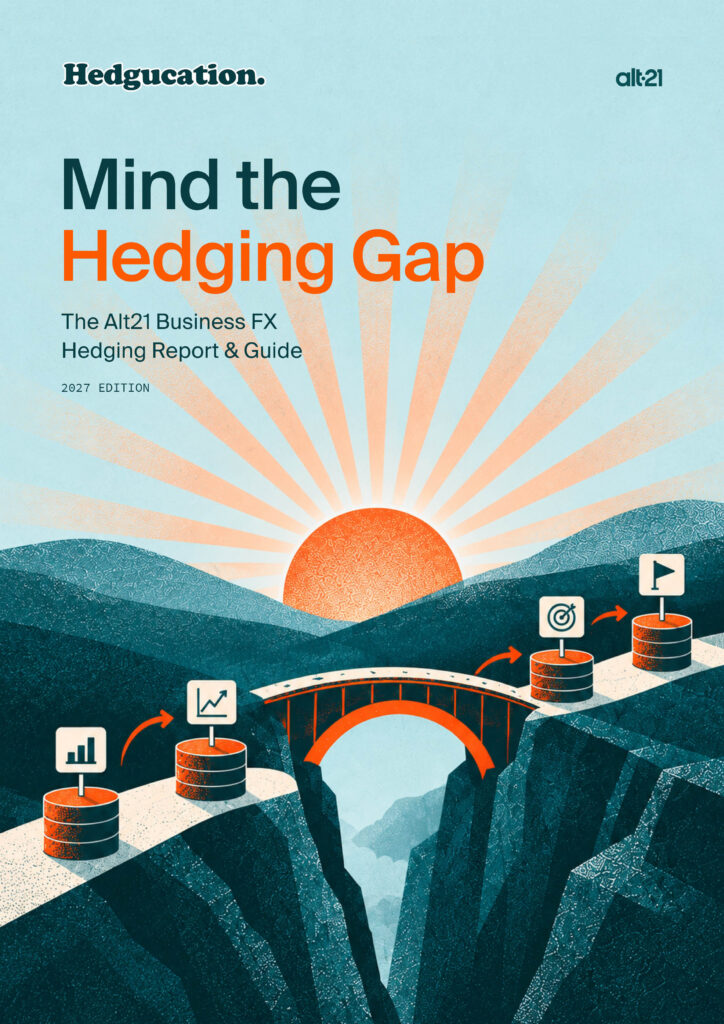
Mind the
Hedging Gap
Explore what FX activity across the UK and Europe reveals about how businesses approach hedging, and get practical guidance on understanding your options and managing future currency exposure.
Where do businesses sit?
We grouped observed FX activity across the UK and Europe into four stages of our Currency Maturity Curve. Select a stage below to explore the findings and see what each one tells us about hedging behaviour.
*Monitor figures are based on hedging quote data from January to October 2026 only.
About the data
This report analyses data from Alt21 clients who opened an account and traded with us at least once over the last five-year period ending October 2026. The Alt21 Currency Maturity Curve groups businesses into four stages based on their observed hedging activity. Trading activity was assessed across the five-year period, while hedging quote data was available from 15 January 2026 onwards. As a result, the React and Monitor classifications should be interpreted with this difference in data availability in mind. Businesses may have explored hedging before January 2026 without that activity being captured in the analysis. The Curve reflects observable activity and does not assess the quality or sophistication of a business's wider treasury or currency management approach.
Mind the gap: the whole UK picture
React is the most common behaviour observed
What we measured
Our data shows that 67.7% of active Alt21 clients in the UK and 65.0% in Europe sit at React on the Alt21 Currency Maturity Curve. These businesses had no recorded Forward Contract or FX Option trades during the five-year period analysed, and no hedging quotes in the available records from January 2026 onwards.
What it tells us
Our data can't tell us why individual businesses haven't used hedging products. Some may have made a considered decision to leave their exposure unhedged, while others may have little reason to hedge. For those exploring their options, the terminology and products can be difficult to navigate. Forward Contracts involve commitments, FX Options have premiums and different risks, and some products may involve collateral requirements. Understanding these costs, risks and obligations can help businesses make informed decisions about whether hedging is appropriate for their circumstances.

“I don’t think every SME needs a sophisticated hedging programme. And I certainly don’t think every business needs every FX product available to them. I do think growing businesses deserve to understand their options.”
Understand the basics of Forward Contracts, FX Options, forward points, premiums and margin calls, with practical explanations of how these products work.
Exploring hedging doesn't always lead to a trade
What we measured
Our data also shows a distinct group of businesses sitting at Monitor. 4.0% of active Alt21 clients in the UK and 4.9% in Europe requested at least one Forward Contract or FX Option quote in the available records from January 2026 onwards, but had no recorded hedging trades during the five-year period analysed.
What it tells us
Our data can't tell us why businesses requested hedging quotes without booking a trade. Their exposure may have changed, the pricing or terms may not have suited their needs, or they may simply have been exploring their options. Beyond the exchange rate, businesses also need to consider costs, contractual commitments, potential collateral requirements and how confident they are in their forecasts. Monitor captures this interest in hedging without a recorded trade. Understanding the amount, currency and timing of a potential exposure, alongside the available products and their terms, can help a business decide whether any further action is appropriate.

“It shouldn’t necessarily just be that your provider is transparent on pricing. It should be that they’re transparent on everything.”
Learn what to consider as future currency requirements become clearer, including timing, forward pricing, collateral and the terms of a hedging quote.
Related Hedgucation lessons
Spot rate vs forward rate Is your broker’s forward rate fair? The real cost of no-fee FXPlan behaviour is at similar levels in the UK and Europe
What we measured
Our data shows 12.4% of active Alt21 clients in the UK and 11.2% in Europe sitting at this stage of the Alt21 Currency Maturity Curve. These businesses booked at least one Forward Contract during the five-year period analysed, without meeting the criteria for Embed. Some booked a single Forward Contract, while others used multiple contracts across different settlement dates.
What it tells us
At Plan, we see businesses beginning to use Forward Contracts to manage future currency exposure, with some booking a single contract and others using multiple contracts across different settlement dates. The proportion of active Alt21 clients classified at this stage was similar in the UK and Europe, although the data can't tell us what influenced their decisions. Once a business starts hedging, questions arise around which exposures to cover, how much to hedge, how far ahead to plan and what to do when forecasts change. Having a clear framework can help businesses make those decisions consistently, based on their currency requirements, risk appetite and financial objectives.

“A hedging programme isn’t a one-off – it needs maintenance as the business changes.”
Explore how businesses can approach decisions about whether to hedge, how much to cover and what to do when forecasts change. Includes a practical framework for putting those decisions into an FX policy.
Embed behaviour is slightly more common in the European group
What we measured
Our data shows 15.8% of active Alt21 clients in the UK and 18.9% in Europe at Embed, the final stage of the Currency Maturity Curve. It is not a target, and many businesses will reasonably choose not to hedge.
What it tells us
For this report, Embed captures businesses that booked FX Options, used rolled or layered Forward Contracts, or demonstrated sustained Forward Contract activity across multiple currency pairs during the five-year period. These behaviours don't necessarily indicate a formal hedging policy or established internal treasury processes. Building on the framework explored at Plan, this section looks at how businesses can incorporate currency management into wider financial planning, connecting exchange-rate assumptions with budgets, forecasts, pricing and margins, and reviewing exposure alongside the cash flows that create it.
“You hedge to the confidence of your exposure.”
Explore how businesses can connect currency decisions to forecasts, budgets and established finance processes, with practical guidance on keeping those decisions under review.
Related Hedgucation lessons
What locked rates let you do The supplier dividend Corporate FX hedging strategiesWhere currency management goes next
The way businesses manage future currency exposure could change considerably over the next few years. Embedded hedging could bring currency management closer to the transactions creating an exposure, while AI could make financial information easier to access and understand.
What stays the same
Businesses will still need to decide whether, when and how much to hedge. Technology could make it easier to apply those decisions within agreed parameters, reducing manual work and making specialist expertise more accessible when it's needed.
“The decision needs to be human. If you’re talking about execution timing, that can be automated within parameters.”
Explore how embedded hedging, AI, automation and new approaches to FX products could change the way businesses manage currency in the future.
Related Hedgucation lessons
Embedded hedging explained Can AI tell you when to hedge? Hedge now, pay later The end of the phone-call hedge?Stay Hedgucated
Hedgucation is Alt21's educational hub for businesses looking to understand FX hedging. Explore videos, practical guides and expert insights that make the terminology, products and decisions involved easier to implement and follow.

Alt21 Limited is authorised and regulated by the Financial Conduct Authority (FRN: 783837) and is an Authorised Payment Institution under the Payment Services Regulations 2017. Alt21 Limited is registered in England and Wales (10723112), with its registered address at 45 Eagle Street, London WC1R 4FS, United Kingdom. Alt21 Limited is not a bank or an e-money institution.
This content is provided for general information and educational purposes only and does not constitute financial advice, a personal recommendation or an offer to buy or sell any financial product. FX hedging is not appropriate for every business. Forward Contracts and FX Options carry financial risks, including the possibility of loss. Businesses should consider their individual circumstances, the relevant product terms and the risks involved before making any hedging decisions.
The findings are based on recorded FX activity among Alt21 clients who opened an account and traded with us at least once during the five-year period ending October 2026. Hedging quote records are available only from 15 January 2026, so the React and Monitor classifications reflect a shorter observation period than the trading data. The Currency Maturity Curve groups observable activity and does not assess a business’s treasury expertise, internal processes or the suitability of its hedging decisions. The findings have not been independently verified and are not representative of all UK or European businesses.
For further details of the methodology, product risks and limitations, please refer to the full report and disclaimer.
Put it into practice with Alt21
Alt21 brings international payments and FX hedging into one platform. See your rate and our margin before you commit, manage Forward Contracts and FX Options directly, and access specialist support when you need it.
FX derivatives involve risk and may not be suitable for every business. Product availability and suitability depend on your circumstances, objectives and relevant terms.