

This guide is provided by Alt21 Limited, trading as Alt21, an FCA authorised payments and FX provider and is intended for UK businesses considering FX hedging as part of their treasury activity. All examples provided are illustrative only and not a current or guaranteed rate. FX hedging products carry risk, including the risk that rates move against you and that you may be asked to provide collateral at short notice, which could affect your cash flow. Comments from Toby Osborne, CFO at Alt21 are contained within the article. As an Alt21 employee, his comments reflect his own experience working with Alt21’s clients and describe Alt21’s own products and approach, rather than independent market commentary. Please read the full disclaimer at the bottom of the page.
If you’re considering hedging, then an FX hedging framework can help you answer the question: should you hedge?
It helps you and your team understand what you’re exposed to, how much that exposure matters for your particular business and what you want your hedge to achieve.
For some, an FX hedge may reduce uncertainty around future exchange rates, making budgeting and forecasting easier. For others, it might add complexity without solving a meaningful problem.
This guide walks through building an FX framework and the factors worth considering, including when the answer to hedging could reasonably be no.
7 Steps to building an FX hedging framework
When you first look at currency hedging, it’s tempting to jump straight to the mechanics.
Forward or option? Three months or twelve? How much should you hedge?
But you’re already several decisions ahead.
Before deciding how to hedge, you need to understand why you’re considering it.
Your objective might be to:
- Make future supplier costs easier to forecast
- Reduce variability against a budget rate
- Give your sales team greater clarity when pricing contracts
- Reduce fluctuations in the value of expected overseas revenue
- Make cash flow planning more predictable
Now let’s break down the FX hedging framework into actionable steps with help from Toby Osborne, Alt21 CFO:
Step 1: What are you actually exposed to?
You can’t decide whether an exposure is worth hedging until you understand what it looks like.
Start with the currencies coming into and leaving your business.
Perhaps you invoice customers in euros but report in pounds. You might buy stock in US dollars, pay contractors in euros or receive revenue in Swiss francs.
Then look at timing.
Is the amount already committed through a signed contract or purchase order?
Is it a recurring payment you can forecast relatively accurately?
Or is it revenue you might receive if your sales pipeline converts?
A €500,000 supplier payment due in three months is very different from €500,000 of potential revenue sitting in a sales forecast.
One is relatively clear. The other could change considerably before the currency ever reaches your account.
A useful exposure map needs more than a currency and an amount. It should help you see:

Step 2: Do some of your exposures already offset each other?
Before looking at a financial hedge, look at what’s happening inside the business.
Imagine you receive €100,000 from customers each month and pay approximately €70,000 to suppliers in euros.
Your gross exposure might look like €170,000 of currency flows.
But those flows move in opposite directions.
If you can use some of the euros you receive to meet euro-denominated costs, the amount you actually need to exchange may be closer to your net €30,000 position.
This is sometimes called a natural hedge.
Research from the Bank for International Settlements1 published in 2025 provides a much larger-scale example of the same principle. Its analysis of non-financial companies found that foreign currency exposures can be offset by other parts of the business, including foreign revenues and assets.
The practical lesson here is:
Look across the business before treating every individual foreign currency transaction as a separate problem.
Step 3: Would exchange-rate movements materially affect your plans?
Finding an exposure still doesn’t answer whether you need to hedge it.
The next question is what happens if the exchange rate changes.
And that isn’t necessarily determined by the size of the currency transaction alone.
A large FX exposure may have relatively little impact on a business with wide margins, while a smaller exposure could matter considerably if it sits inside a transaction with a narrow margin.
Toby thinks about materiality in terms of what the currency movement could do to the economics of the business:
“It’s not about the notional per se. It’s about how that’s going to erode the net profit on that transaction.”
Imagine you sell something for £100 with an £80 cost base. If exchange-rate movements increase the FX-affected portion of that cost enough to take your total cost from £80 to £85, your profit falls from £20 to £15.
The currency movement hasn’t reduced your profit by 5%. It has reduced it by 25%.
That’s why looking at currency exposure alongside your planned margins can tell you far more than looking at the FX amount in isolation.
- Would the difference be relatively easy to absorb?
- Would you change your pricing?
- Would planned margins become harder to maintain?
- Would it create a meaningful variance against your budget or forecast?
- Would it affect cash you’d planned to use elsewhere?
Step 4: How much variation are you prepared to accept?
Not every business needs the same degree of predictability.
One practical way to think about this is to imagine the exchange rate has already moved.
What level of movement could you comfortably explain to the board as an acceptable business outcome?
That answer will differ considerably between businesses. A company with wider margins may be able to absorb more variation. Another operating on narrow margins may find that a relatively small currency movement materially changes the economics of a contract.
You’re not trying to decide how much the currency will move. You’re establishing how much variation the business can reasonably accommodate if it does.
That parameter can then inform your approach to currency management, but it doesn’t need to be an elaborate treasury exercise, especially if you’re a growing finance team. All you’re doing here is establishing the boundaries within which your business is comfortable operating.
Step 5: How confident are you in the underlying forecast?
There’s another side to the decision.
You might have a large exposure and still have very little confidence that it’ll happen exactly as forecast.
This is important because a hedge doesn’t automatically change when your forecast does.
Imagine you expect to receive $1 million from customers over the next six months and hedge the entire amount. If sales later come in at $700,000, your original exposure has changed, but your existing hedge hasn’t.
Before deciding how much of an exposure you might want to cover, look at what sits behind the forecast.
A signed customer contract or confirmed supplier order gives you more information to work with than an opportunity sitting in your sales pipeline.
Recurring payments can also become easier to forecast when you have enough historical data to understand how much they typically vary from month to month. You can then separate your exposures into broad levels of confidence:
- Committed: The amount and timing are largely known, such as an agreed supplier payment
- Highly probable: The cash flow isn’t contractually fixed, but you have good reason to expect it based on recurring activity or reliable forecasts
- Uncertain: The amount, timing or likelihood could still change significantly
Once you know this, look into how accurate similar forecasts have been in the past. If you regularly forecast €500,000 of quarterly revenue but actual receipts tend to land somewhere between €350,000 and €450,000, that variance is useful information. It tells you something about how much confidence to place in the headline forecast.
Timing deserves the same scrutiny. You may be confident that a payment will happen but less certain about when. A customer paying 30 days later than expected or a supplier order moving into the following quarter can change the exposure you originally planned around.
Generally, committed payments or highly predictable recurring cash flows give you a clearer starting point than uncertain forecasts further into the future.
This is also why “Should we hedge?” and “How much should we hedge?” are separate questions.
Deciding that an exposure is worth managing doesn’t mean you necessarily need to cover 100% of it.
Toby describes the principle simply:
“You hedge to the confidence of your exposure.”
In practice, that means the reliability of the underlying cash flow becomes part of the decision. A contracted payment due in 90 days gives you considerably more information than pipeline revenue expected nine months from now.
And finance can’t necessarily assess forecast confidence in isolation.
Sales may know how firm the order book is. Procurement may know how likely supplier volumes are to change. Credit control may know that a customer who usually pays reliably has started slipping beyond agreed terms.
“Finance can’t be doing it in isolation,” Toby says. “They have to be having the conversation with the rest of the company.”
As the underlying business changes, your view of the exposure may need to change with it.
Step 6: What would you be giving up or taking on?
Hedging changes the nature of your exposure. It doesn’t make every form of uncertainty disappear.
A Forward Contract, for example, allows you to agree on an exchange rate for an agreed future transaction. That can help with planning, but you’re committing to the agreed rate even if the market subsequently moves in your favour.
Depending on the product and provider, there may also be collateral requirements, credit considerations, premiums, contractual commitments or other costs to understand.
An FX Option works differently. It can provide more flexibility because you have a right rather than an obligation to transact at the agreed rate, but that optionality can involve an upfront premium.
Before comparing products, it also helps to be clear about what the business actually expects the hedge to do.
Toby points to a distinction he has seen between the priorities of finance teams and those of other decision-makers. A CFO may be primarily focused on reducing variability around a known cost, while a CEO or board may also want to retain some ability to benefit if exchange rates move favourably.
Neither objective automatically determines the answer, but they lead to different conversations about what the business is willing to give up, what flexibility it values and what costs it’s prepared to take on.
Learn more about the difference between Forward Contracts vs FX Options.
The question isn’t simply:
What happens if we don’t hedge?
It’s also:
What changes if we do?
Understanding both sides gives you a much stronger basis for deciding whether hedging fits what you’re trying to achieve.
Step 7: Could doing nothing be a reasonable decision?
Yes. There are businesses where not using an FX hedge can be a perfectly reasonable outcome.
Toby reduces the decision to two particularly useful questions:
How material would the outcome be?
How confident are you that the exposure will actually occur?
If reasonable exchange-rate movements wouldn’t materially affect your plans, introducing a hedge may add complexity without solving a significant business problem.
Equally, an exposure can look large on paper but still be difficult to hedge appropriately if the underlying transaction is highly uncertain. Pipeline revenue, variable purchasing volumes or a tender that hasn’t yet been won all involve different levels of confidence.
You might decide not to hedge when:
- Your net currency exposure is relatively small
- Incoming and outgoing currency flows naturally offset each other
- Your pricing can adjust relatively quickly when exchange rates change
- The financial impact of reasonable currency movements is immaterial to your plans
- Your forecast is too uncertain to make a contractual commitment appropriate
- The costs, or operational requirements, outweigh the planning benefit you’d gain
If you’re an SMB and hedging seems daunting, bear in mind that even large companies don’t universally hedge every currency exposure. Businesses may choose not to hedge because of cost, oversight requirements or a desire to retain potential upside from favourable exchange-rate movements.
FX hedging framework template
Put everything together and your first decision tree can be surprisingly straightforward.
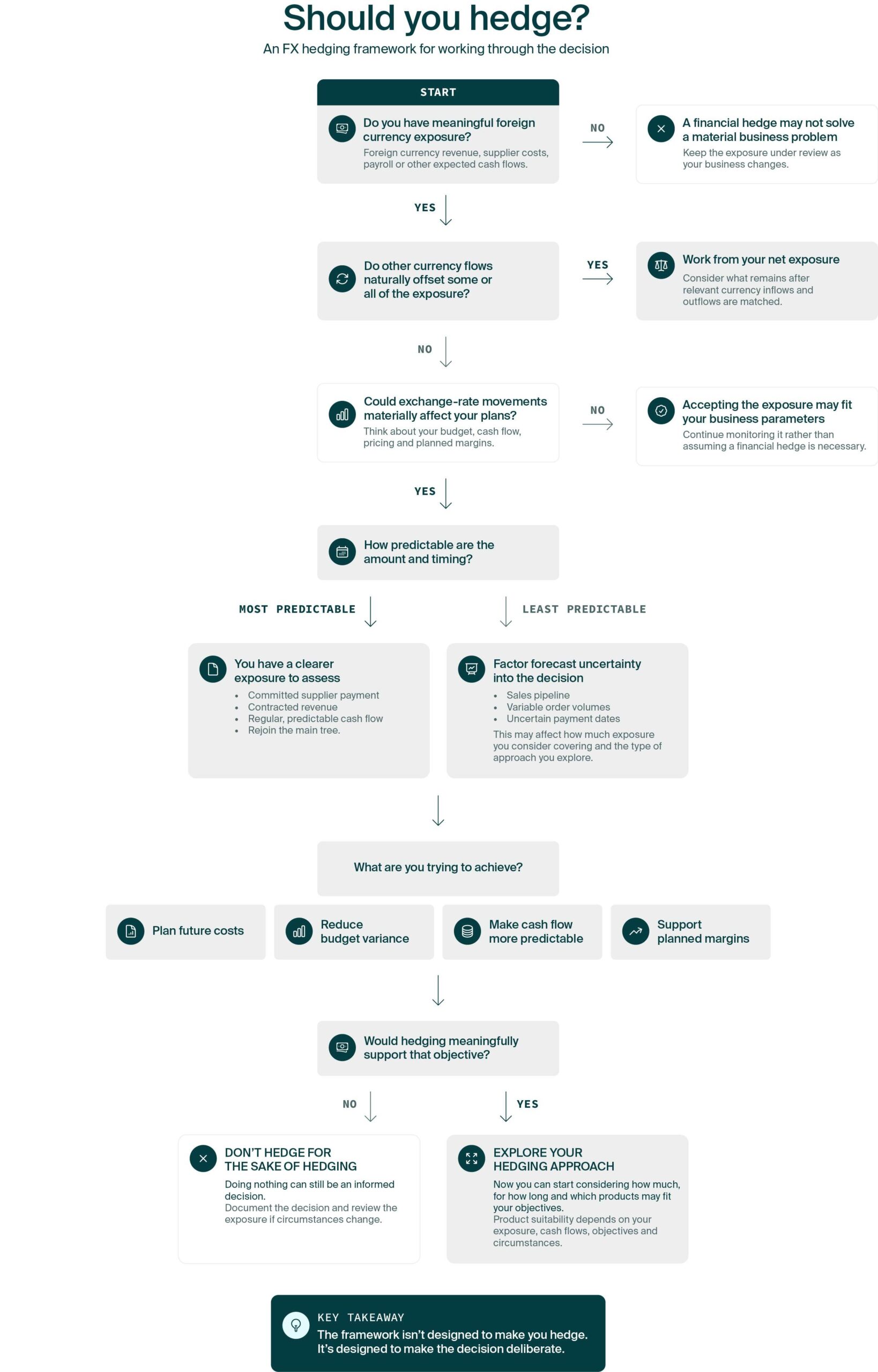
1. Do you have meaningful foreign currency exposure?
If no, a financial hedge may not solve a material business problem.
If yes, keep going.
2. Does another part of the business naturally offset it?
If yes, assess your net exposure rather than automatically hedging the gross amount.
If no, keep going.
3. Would a reasonable exchange-rate movement materially affect your budget, cash flow, pricing or planned margins?
If no, accepting the exposure may fit within your parameters.
If yes, keep going.
4. Is the amount and timing sufficiently predictable?
If no, consider whether the uncertainty changes how much exposure you’d want to cover or whether a more flexible approach is worth exploring.
If yes, keep going.
5. What outcome are you trying to achieve?
Define it before choosing a product.
That might be greater visibility over future costs, a narrower range of budget outcomes or more predictable cash flows.
Only then does the conversation move to the mechanics:
How much to hedge, over what period and which products might fit those objectives.
But, keep in mind:
A hedging framework isn’t something you build once and forget.
The assumptions underneath your exposure can change. Sales forecasts move. Customers pay later than expected. Supplier volumes change. A contract ends. Procurement finds a new supplier in another currency.
That means an exposure that looked highly predictable three months ago may look very different today.
As Toby puts it:
‘A hedging programme isn’t a one-off – it needs maintaining as the business changes.’
That doesn’t mean rebuilding your approach every week. It means periodically checking whether the exposure you originally assessed still reflects what’s actually happening in the business.
The more uncertain your forecasts are, the more important that review becomes.
A framework is more useful than a market view
You’ll notice one question that doesn’t appear anywhere in this framework:
Where do you think the exchange rate is going?
That’s deliberate.
A hedging decision shouldn’t begin with a prediction about whether sterling, the euro or the dollar will rise or fall.
It should begin by understanding what different outcomes would mean for your business.
Once you know your exposure, its financial impact, the reliability of your forecasts and what you’re trying to achieve, you’ve got a much stronger foundation for deciding what happens next.
Sometimes that might lead you towards hedging. Other times, it might lead you towards changing how you invoice, matching currency inflows and outflows or reviewing your pricing. And sometimes the answer may genuinely be to do nothing.
If you’re looking for a platform that brings your Spot conversions, Forwards and Options together in one place, take a look at Alt21.
ALT21 Limited is authorised and regulated by the Financial Conduct Authority (FRN: 783837) and is a company registered in England and Wales (number 10723112). The registered address is 45 Eagle Street, London WC1R 4FS, United Kingdom. This article has been produced by ALT21 Limited for information purposes only. It does not constitute financial advice or an offer to sell or the solicitation of an offer to buy any products referenced. Hedging products are not suitable for every business. Before entering into any FX product, you should consider whether it is appropriate for your needs and circumstances. ALT21 Limited assumes no liability for errors, inaccuracies or omissions. Eligibility criteria and terms and conditions apply to all products and services offered by ALT21 Limited. Not all applications will be accepted.
1. https://www.bis.org/publ/work1303.htm