


This guide is provided by Alt21 Limited, trading as Alt21, an FCA authorised payments and FX provider and is intended for UK businesses considering FX hedging as part of their treasury activity. All examples provided are illustrative only and not a current or guaranteed rate. FX hedging products carry risk, including the risk that rates move against you and that you may be asked to provide collateral at short notice, which could affect your cash flow. Comments from Toby Osborne, CFO at Alt21 are contained within the article. As an Alt21 employee, his comments reflect his own experience working with Alt21’s clients and describe Alt21’s own products and approach, rather than independent market commentary. Please read the full disclaimer at the bottom of the page.
Your hedging approach shouldn’t change every time the exchange rate does.
How much do you hedge? How far ahead? Who makes the call? And what happens when the forecast changes?
An FX hedging policy gives your finance team an agreed framework for answering those questions, so you’re not rebuilding your approach every time a currency decision lands on your desk.
And it doesn’t need to become a three-week policy project.
If you need to get something practical in place, this guide will help you build the foundations of your FX hedging policy in an afternoon, with a one-page template you can adapt to your business.
What is an FX hedging policy?
An FX hedging policy is an internal document that sets out how your business approaches foreign exchange exposure.
Think of it as the rulebook for your FX plan.
Your wider FX hedging strategy sets out where you want to go. Your policy defines how you’ll get there, setting the parameters for what you hedge, when you hedge and who can make those decisions.
Depending on your business, it might establish:
- The purpose of your hedging activity
- Which currencies and exposures are covered
- What percentage of exposure may be hedged
- How far ahead you can hedge
- Which FX products are permitted
- Who can enter into or approve transactions
- How positions are monitored and reported
- What happens when forecasts change
- When the policy needs to be reviewed
Remember, if every FX decision starts with “What’s the rate today?”, your approach can quickly become influenced by what the market happens to be doing at that moment.
A policy gives you a different starting point:
“What did we agree we were trying to achieve?”
Why have an FX hedging policy?
You can hedge without a formal written policy. But as your currency exposure grows, informal decision-making can become harder to manage.
You might find that one person hedges six months ahead, while another may wait until an invoice is due. One currency might be mostly hedged while another is left open. Decisions can gradually become dependent on who’s making them and what they think the market might do.
A written policy creates a common FX hedging framework.
Here’s how it helps:
- It can help you establish consistency by giving your team agreed parameters to work within rather than reconsidering the entire approach for every transaction.
- It can improve governance because responsibilities, approval limits and permitted activities are documented.
- It can make reporting easier because you have something concrete against which to review your activity.
And importantly, it can separate commercial objectives from market views.
As Toby Osborne, CFO at Alt21, puts it:
“The great tragedy of hedging is that you can always see the opportunity and back trade.”
Once you know where the market went, it’s easy to look back and decide that you should have hedged more, hedged less or acted at a different time.
A policy gives you the parameters that were agreed when the outcome was still unknown. You can then look at whether the business followed its process and worked towards its stated objectives.
There’s no single template for how a business should approach currency exposure. Your FX hedging policy needs to reflect your exposures, cash flows and objectives.
That’s why your policy needs to start with your business, not an FX product.
Creating an FX policy in 9 steps
Step 1: Before you write anything, answer one question
What are you trying to achieve?
This is arguably the most important part of your FX hedging policy.
Not:
“What percentage should we hedge?”
Or:
“Should we use forwards or options?”
And definitely not:
“Where do we think GBP/EUR will be in six months?”
Start with the business outcome.
You might want to improve the predictability of supplier costs, or reduce the effect that exchange-rate movements can have on your budget.
You might need greater visibility over future cash requirements, or support planned FX margins on contracts priced months before the associated foreign-currency costs are paid.
Or you might simply want everyone in the business to follow the same process.
For many finance teams, the starting point may already exist in the annual budget or sales plan.
If that plan was built using particular exchange-rate assumptions, consider what FX outcome the business needs to support the revenue, costs and margins behind it. Your policy can then establish how future currency exposure will be managed in relation to those assumptions.
From there, you can consider how reliably you can forecast the underlying cash flows, how far ahead that visibility extends and how much flexibility the business wants within its approach.
Your objective then shapes what belongs in the rest of the policy.
Example objective
Your first draft doesn’t need to sound like a legal document.
It could be as straightforward as:
The purpose of this policy is to establish a consistent approach to managing material foreign-currency exposure, supporting financial planning and reducing unnecessary variation against agreed budgets.
Your actual wording should reflect your circumstances.
What matters is that someone reading the policy can understand why it exists.
Step 2: Define what sits inside your FX hedging policy
Once you know the objective, define the scope.
Start by listing the currency exposures your business actually has.
These could include:
- Overseas supplier payments
- Foreign-currency customer receipts
- International payroll
- Inter-company payments
- Foreign-currency debt
- Contracted purchases or sales
- Highly probable forecast transactions
You may decide that some exposures belong inside the policy while others don’t.
For example, a business might manage contracted supplier payments but decide not to hedge less predictable forecast purchases beyond a certain point.
That isn’t necessarily an inconsistency.
The certainty of the underlying exposure matters.
A confirmed invoice due next month is different from a sales forecast nine months away. Treating them identically could create problems of its own.
Your policy should therefore make clear both what you may hedge and the conditions under which you’ll consider it.
Don’t forget natural offsets
Before deciding what needs hedging, look at your exposures together.
Imagine you expect to receive €500,000 from customers and pay €350,000 to suppliers over roughly the same period.
Looking at the two sides independently could make your gross currency activity appear to be €850,000.
But economically, part of that exposure may offset.
Understanding those natural offsets can help you identify the residual exposure that actually needs consideration.
This is why exposure visibility comes before choosing an FX product.
Step 3: Decide how much exposure falls within your hedging parameters
Your next decision is your hedge ratio.
A hedge ratio is simply the proportion of an identified currency exposure that you hedge.
For example, if you expect to make a €500,000 payment and hedge €300,000, your hedge ratio is 60%.
But there’s no universal percentage that every finance team should use.
The appropriate range depends on factors including:
- How predictable your exposure is
- How far ahead you can forecast reliably
- Your commercial objectives
- Your margins
- Your cash position
- Your risk parameters
- The flexibility you need if forecasts change
One useful way to approach this is to connect the hedge ratio to forecast certainty.
You might be comfortable covering a greater proportion of committed exposure due within three months than forecast exposure expected in nine months.
Instead of one fixed percentage, your policy could therefore use ranges.
For example:
These figures are illustrative only, not recommended hedge ratios.
| Forecast period | Illustrative policy range |
| 0–3 months | 70–100% |
| 4–6 months | 40–80% |
| 7–12 months | 0–50% |
| 12+ months | Case-by-case |
The point is the structure.
As your ability to forecast an exposure changes, your policy can allow your hedge coverage to change with it.
That gives you parameters without pretending every forecast carries the same level of certainty.
Step 4: Set your hedging horizon
Your hedge ratio answers how much.
Your hedging horizon answers how far ahead.
Again, this needs to reflect how your business operates.
A business that agrees supplier orders 12 months in advance has a different planning horizon from one whose overseas costs become clear only a few weeks before payment.
Your policy might therefore say that the business can hedge confirmed exposures up to 12 months ahead but forecast exposures only up to six months ahead.
Or it could establish different parameters for different types of exposure.
What matters is that your horizon is connected to something commercially meaningful.
Ask:
How far ahead can we see our exposure with enough reliability for it to inform a hedging decision?
That’s a much more useful starting point than simply choosing the longest contract your provider offers.
Step 5: Define which FX products can be used
Now you can get to the products.
Your FX hedging policy should state which instruments are permitted under the policy and, where appropriate, the circumstances in which they may be considered.
For many businesses, that could include a relatively small selection.
Spot FX
A spot transaction exchanges one currency for another at the current exchange rate, typically for settlement shortly afterwards.
Spot FX isn’t a hedge against a future rate movement, but it may still form part of your broader FX policy for immediate currency requirements.
Forward contracts
A forward contract lets you agree an exchange rate now for a specified amount of currency to be exchanged at an agreed future date or during an agreed period.
Businesses often consider forwards when they want greater visibility over the exchange rate attached to a future payment or receipt.
A forward also fixes the rate for that transaction, which means you won’t benefit if the market subsequently moves in your favour, and it carries counterparty risk in the same way any contractual agreement does.
They also create an obligation.
If the underlying commercial exposure changes, you may still have contractual obligations under the forward. Depending on the agreement and market movement, amending or closing a forward can result in a financial gain or loss.
That’s one reason your hedge ratio and forecast reliability matter.
FX options
FX options can provide the right, but not the obligation, to exchange currency at an agreed rate, depending on the type and structure of the option.
That can provide more flexibility than a forward in certain circumstances, but options may involve an upfront, non-refundable premium or other costs, and more complex structures can create additional risks and obligations.
The suitability of any FX product depends on your objectives, exposure and circumstances.
Your policy doesn’t need to list every instrument available in the FX market.
In fact, a shorter approved list can make governance clearer.
It can also specify products that aren’t permitted without additional approval.
Step 6: Decide who can do what
An FX policy may sit with finance day-to-day, but setting it can involve a wider group of people.
Sales may hold information about expected revenue. Procurement or operations may have visibility over future purchasing requirements. Senior leadership and the board can establish the wider financial parameters within which the business wants to operate.
Toby summarises the distinction simply:
“You’ve got to get the head of sales and the CEO in… whatever the whole framework is, you need that to be agreed. Once drafted and agreed, the CFO runs it.”
In practice, the exact roles will depend on the structure of your business. Once those roles are agreed, you can separate them into four areas:
Policy ownership
Who’s responsible for maintaining the document?
Execution
Who can enter into FX transactions?
Approval
Does another person need to approve transactions above a particular amount or outside standard parameters?
Oversight
Who reviews overall exposure and reports it to senior management or the board?
In a smaller finance team, one person may hold several of these responsibilities. That’s fine. The important thing is that it’s written down.
Example authority structure
| Activity | Responsibility |
| Maintain FX exposure forecast | Finance team |
| Execute within approved policy | Authorised finance team members |
| Approve transactions above agreed threshold | Finance Director/CFO |
| Approve policy exceptions | Finance Director/CFO or board, as applicable |
| Review policy | Named policy owner and appropriate governance body |
Your exact governance structure will depend on your business.
You may also want to include transaction limits.
For example, an authorised finance manager might be able to execute transactions within agreed policy parameters up to a specified amount, with larger transactions requiring additional approval.
The objective is to make authority visible.
Step 7: Decide what happens when the forecast changes
This section is easy to overlook, but it’s also one of the most useful parts of the policy.
Say your forecast said you’d need €400,000. Three months later, the order was delayed. The customer changes the contract. Sales come in below forecast.
Your exposure has changed, but your hedge may not have.
What happens next?
Your FX hedging policy should define how material changes to forecast exposure are identified, reported and reviewed.
That could include:
- How frequently forecasts are refreshed
- What level of forecast variance triggers a review
- Who decides whether an existing hedge needs to be adjusted
- How over-hedged positions are handled
- Who approves exceptions to the standard policy
This is also why hedging 100% of every forecast isn’t automatically the most cautious approach.
If the underlying transaction is uncertain, committing to exchange the full forecast amount could leave you with a currency contract that’s larger than the commercial exposure it was intended to cover.
Your policy needs to consider both sides of that equation.
Step 8: Define how you’ll measure whether the policy is working
There’s a tempting way to judge a hedge:
Was the hedged rate better than the spot rate in the end?
Once you know where the market eventually moved, that comparison is easy to make. But it doesn’t tell you whether the policy achieved the objective the business originally set.
Toby gives a simple example:
“Imagine the business built its budget around a rate of £1.35 and subsequently achieved that rate through its hedging programme. The market later moves to £1.30, which would have produced a more favourable outcome.”
Looking backwards, it’s tempting to focus on the opportunity you missed:
“We shouldn’t have hedged at £1.35. It’s moved to £1.30… Well, no. You made budget.”
At the point the original decision was made, the later market movement wasn’t known. If the objective was to support the assumptions behind the agreed budget, performance can be assessed against that objective.
That means looking at both the financial outcome and whether the policy was actually followed.
Your policy could therefore establish measures such as:
- FX variance against budget
- Percentage of exposure hedged versus policy parameters
- Forecast accuracy
- Number of policy exceptions
- Hedging costs
- Open exposure by currency
- Average or blended hedged rate
- Upcoming hedge maturities
The measures you choose should link back to the objective you wrote at the beginning:
- If your policy exists to support budgeting, measure budgeting outcomes:
- If it exists to create consistency, measure compliance with the agreed framework.
- If it exists to improve visibility, report the information decision-makers actually need.
Otherwise, you risk judging a policy against something it was never designed to achieve.
Step 9: Decide when you’ll review your FX hedging policy
An FX hedging policy shouldn’t disappear into a folder once it’s approved.
When your business changes, your currency exposure changes with it.
A sensible policy therefore includes a review schedule. That might be annually, every six months or at another interval appropriate to your business.
Your policy can also establish how frequently the hedging process itself is refreshed. For a business using a rolling approach, that might mean reviewing exposure and extending coverage at regular intervals rather than waiting for the existing hedges to reach the end of their horizon.
You can also define events that trigger an earlier review.
For example:
- Entering a new market
- Adding a material new currency exposure
- A significant change in revenue or supplier mix
- An acquisition or disposal
- A major change to forecast accuracy
- Changes to financing arrangements
- Material changes to your operating model
- Repeated breaches of existing policy parameters
A review doesn’t mean rewriting the policy every time. Sometimes the answer will be that the existing framework still fits. The important thing is that somebody checks.
Your one-page FX hedging policy template
Now we can put everything together.
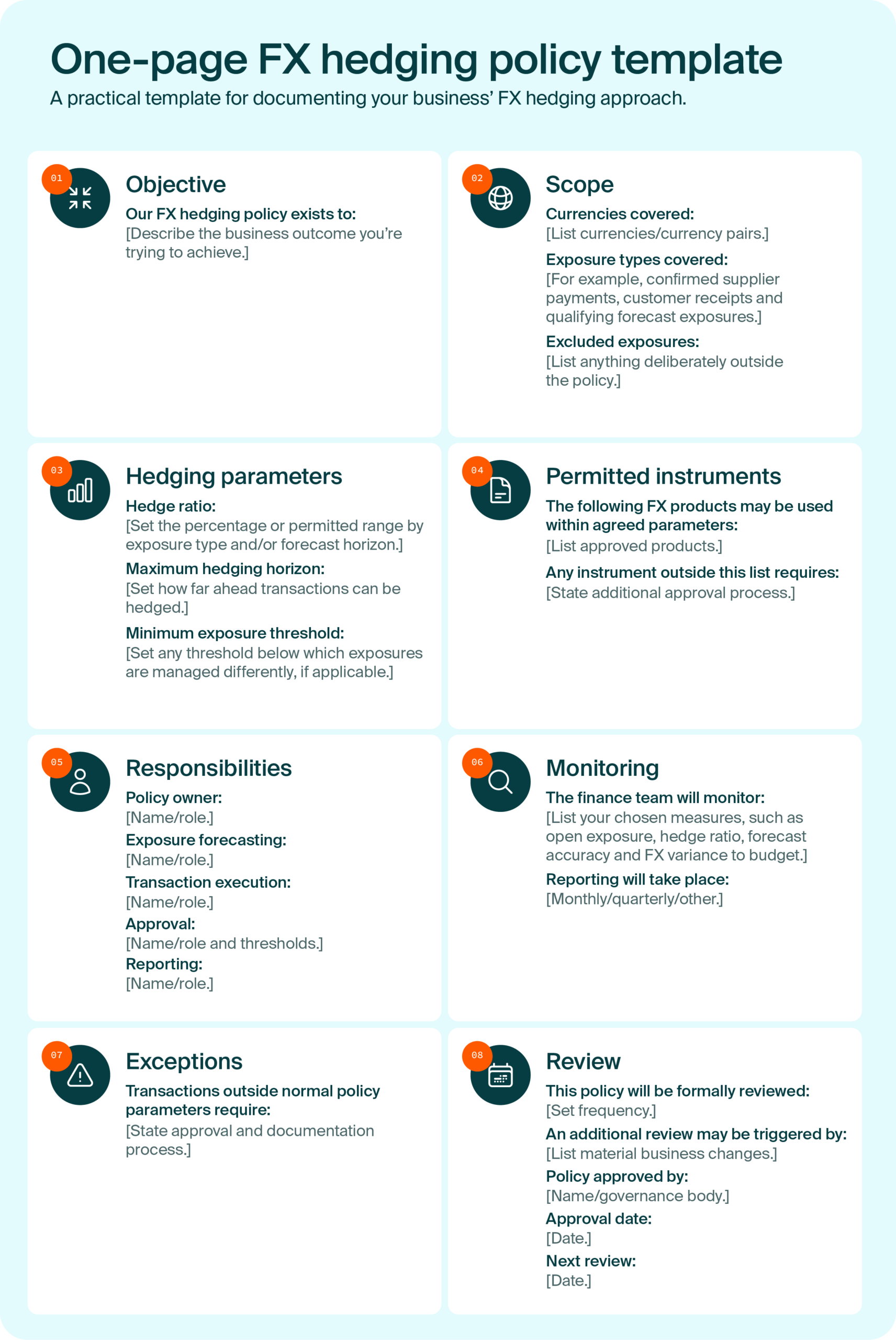
Your actual policy may eventually need more detail depending on your governance, accounting requirements, currencies, products and business structure.
But if you’re starting from a blank page, this gives you somewhere practical to begin.
1. Objective
Our FX hedging policy exists to:
[Describe the business outcome you’re trying to achieve.]
2. Scope
Currencies covered:
[List currencies/currency pairs.]
Exposure types covered:
[For example, confirmed supplier payments, customer receipts and qualifying forecast exposures.]
Excluded exposures:
[List anything deliberately outside the policy.]
3. Hedging parameters
Hedge ratio:
[Set the percentage or permitted range by exposure type and/or forecast horizon.]
Maximum hedging horizon:
[Set how far ahead transactions can be hedged.]
Minimum exposure threshold:
[Set any threshold below which exposures are managed differently, if applicable.]
4. Permitted instruments
The following FX products may be used within agreed parameters:
[List approved products.]
Any instrument outside this list requires:
[State additional approval process.]
5. Responsibilities
Policy owner:
[Name/role.]
Exposure forecasting:
[Name/role.]
Transaction execution:
[Name/role.]
Approval:
[Name/role and thresholds.]
Reporting:
[Name/role.]
6. Monitoring
The finance team will monitor:
[List your chosen measures, such as open exposure, hedge ratio, forecast accuracy and FX variance to budget.]
Reporting will take place:
[Monthly/quarterly/other.]
7. Exceptions
Transactions outside normal policy parameters require:
[State approval and documentation process.]
8. Review
This policy will be formally reviewed:
[Set frequency.]
An additional review may be triggered by:
[List material business changes.]
Policy approved by:
[Name/governance body.]
Approval date:
[Date.]
Next review:
[Date.]
That’s your first version – Not 30 pages or a treasury textbook. Just a clear statement of what you’re trying to achieve and the boundaries within which your team can make FX decisions.
The golden rule to keep in mind:
Your FX hedging policy should be boring.
A useful policy takes much of the drama out of individual currency decisions. You’ve already agreed what counts as material exposure, established who can approve transactions and set the parameters your team can work within.
Those parameters can still leave room for judgement.
For example, your policy might permit a hedge ratio within an agreed range rather than requiring an exact percentage at every point in the forecast.
Toby cautions against trying to make those rules too precise:
“Narrowing it down to say you must be 83% hedged six months out is a recipe for failure because you can’t be that accurate.”
A range can give your finance team room to respond as sales forecasts, purchasing plans and other commercial information change, while keeping decisions within boundaries the business has already agreed.
The policy establishes where that judgement is allowed, who can exercise it and when a decision needs to be escalated.
Common FX hedging policy mistakes
Even a short policy can become less useful if it doesn’t reflect how your business actually operates.
Starting with the product
“We use forward contracts” isn’t an FX hedging policy.
It tells you what you’re currently using, but not why, how much, when or under whose authority.
Start with the objective and exposure; then you can find the product that’s right for your business.
Making market predictions part of the policy
Exchange-rate forecasts can inform wider analysis, but a governance document built around predicting where currencies will move can quickly become difficult to apply consistently.
Your policy is there to establish how your business approaches exposure, not to prove you can forecast FX markets.
Hedging forecasts as though they’re confirmed cash flows
The further ahead you forecast, the more your underlying commercial position may change.
Your policy should acknowledge that difference rather than treating every expected transaction as equally certain.
Forgetting what happens when things change
A policy that explains how to enter a hedge but not what happens when the underlying exposure changes is incomplete.
Build exceptions, forecast changes and escalation into the document from the beginning.
Never reviewing it
A policy written for the business you had three years ago may not reflect the business you have today.
The document should evolve as your exposures, forecasts, operations and objectives change.
From FX decisions to an FX process
Without an FX framework, decisions can happen transaction by transaction. A policy moves many of those decisions upstream. Your team has already agreed what falls within scope, the parameters you’ll work within and who has authority to make decisions. Each transaction becomes part of an established process rather than a fresh strategic decision.
Writing that process down is only the first step. You also need the visibility and tools to put it into practice. That means understanding your currency exposure, seeing what’s already hedged, identifying what remains open and managing transactions within your agreed parameters.
Alt21 brings international payments and FX hedging together in one multi-currency management platform, helping your finance team put that process into practice. You can see and manage your currency activity in one place, with access to Spot FX, Forward Contracts and FX Options depending on your circumstances and objectives.
Your policy sets the parameters. Alt21 gives you the tools to work within them.
Open an Alt21 account. Applicants must pass Alt21’s onboarding process and accept our terms and conditions before becoming a client.

FAQs
Should an FX hedging policy include exchange-rate forecasts?
An FX hedging policy generally focuses on the rules and objectives governing how currency exposure is managed rather than trying to predict future exchange rates.
The aim is to establish a repeatable decision-making framework.
What’s the difference between an FX hedging policy and an FX hedging strategy?
An FX hedging strategy describes the broader approach your business takes to managing currency exposure.
Your FX hedging policy documents the rules for applying that strategy, including scope, hedge ratios, permitted products, responsibilities, approvals, reporting and reviews.
In simple terms, the strategy explains how you want to approach FX. The policy explains how your team puts that approach into practice.
Can you write an FX hedging policy without a treasury team?
You don’t necessarily need a dedicated treasury function to document how your business approaches FX exposure.
A clear policy can be particularly useful where FX responsibilities sit within a broader finance team because it establishes ownership, parameters and approval processes without relying on informal knowledge.
The appropriate level of detail will depend on the size and complexity of your currency exposure.
ALT21 Limited is authorised and regulated by the Financial Conduct Authority (FRN: 783837) and is a company registered in England and Wales (number 10723112). The registered address is 45 Eagle Street, London WC1R 4FS, United Kingdom. This article has been produced by ALT21 Limited for information purposes only. It does not constitute financial advice or an offer to sell or the solicitation of an offer to buy any products referenced. Hedging products are not suitable for every business. Before entering into any FX product, you should consider whether it is appropriate for your needs and circumstances. ALT21 Limited assumes no liability for errors, inaccuracies or omissions. Eligibility criteria and terms and conditions apply to all products and services offered by ALT21 Limited. Not all applications will be accepted.