

This guide is provided by Alt21 Limited, an FCA authorised payments and FX provider.
FX international payments sit at the heart of international business, but they’re often misunderstood. Many finance teams focus on getting money from A to B without realising that the foreign exchange behind every payment can have just as much impact as the payment itself.
Knowing more before you pay means understanding how exchange rates, fees and payment methods influence every transaction.
In this guide, we’ll break down the essentials of FX international payments so you can make more informed decisions as your business grows across borders.
Quick summary
- FX international payments are payments made by a business between two countries where one currency will be exchanged for another.
- Popular types of payments include bank transfers, online platforms, wire transfers, local payment networks and multi-currency accounts.
- International payments follow a five-step process to work: initiation, exchange rate application, messaging, conversion and settlement.
- The overall cost is determined by the exchange rate offered, FX margins, transfer fees, bank charges and the type of payment method used.
- Benefits include access to global markets, paying and receiving currencies in local markets, the improvement of operational efficiency and a greater visibility over international finances.
- Challenges include exchange rate movements, hidden fees and complexity with scale.
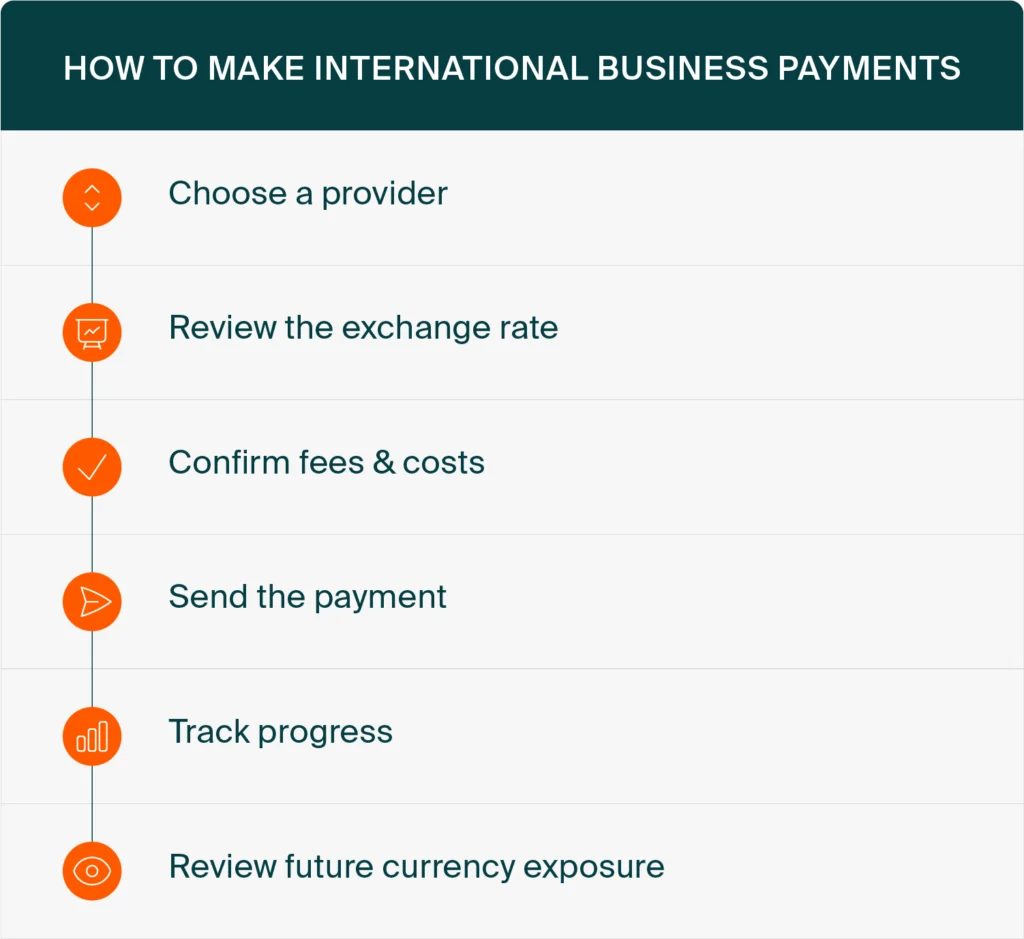
- To make an international payment as a business is to choose a provider, review the exchange rate, confirm the fees and costs, send the payment and then review the future currency exposure.
- To track international payments, you could contact your bank or wait for updates, or you can use a platform like Alt21 for real-time tracking.
- Choosing a FX international payment provider is subject to what your business requires. Some factors to look for include transparency, competitive exchange rates, the speed of payments, currency coverage, multicurrency capabilities, visibility beyond payments and how they support you beyond payments.
What are FX international payments?
An FX international payment is any payment made between two countries that requires one currency to be exchanged for another. If your business pays a supplier in euros from a UK pound sterling account, receives US dollars from an overseas customer or settles invoices in Japanese yen, foreign exchange (FX) forms part of the transaction.
While the payment itself moves money from one account to another, the foreign exchange determines how much one currency is worth against another at the time of the transaction. That means the exchange rate you receive can have a direct impact on your costs, margins and cash flow.
For businesses trading internationally, FX international payments are part of everyday operations. They’re used to:
-
-
- Pay overseas suppliers and manufacturers
-
- Receive payments from international customers
-
- Settle invoices in foreign currencies
-
- Manage international payroll
-
- Transfer funds between overseas entities
-
- Support imports and exports
-
For many businesses a slight difference in exchange rates or fees may seem insignificant, but the numbers do add up, and when you’re making regular international payments you’ll start to notice it.
Types of FX payments
There are several kinds of FX payments a business can make. The best option depends on where you’re sending money, how quickly you need it to arrive and the level of transparency and control needed by your business.
Here are some of the most popular international payment methods for businesses:
Bank transfers
Bank transfers are one of the most widely used methods for making international payments. They are typically one of the lower-cost methods, though pricing varies by bank.
However, keep in mind that while they are suitable for high-value transactions the cost will depend on the bank, and some may add additional processing time and fees.
Many cross-border transfers are sent through the SWIFT network, allowing banks around the world to communicate securely.
Online FX payment platforms
The next type of international payment is dedicated FX providers. They allow businesses to exchange currencies and send payments through an online platform.
These providers can offer greater visibility than some traditional channels typically provide while giving finance teams more control over international payments.
Many also provide additional features such as multi-currency accounts, payment tracking and automated workflows.
International wire transfers
Wire transfers move funds electronically between financial institutions and are commonly used for urgent or high-value international payments.
You may hear a “wire transfer” referred to as a “bank transfer” but they are two different types of payments.
International wire transfers are typically instant and processed through global banking networks. This does make them more costly than your typical bank transfer.
Local payment networks
In some countries, providers can use local payment rails instead of international banking networks. This can reduce costs and improve payment speeds because funds are settled domestically once they’ve reached the destination country.
Multi-currency accounts
Businesses trading in multiple markets often use multi-currency accounts to hold, receive and send funds in different currencies without converting them immediately.
Multi-currency accounts are a good option if your finance team is after more flexibility over international cash flow. Rather than exchanging money every time a payment is made, they can decide when it makes commercial sense to convert currencies.
Quick tip: The best international payment method is the one that provides the right balance of cost, transparency and flexibility for your business.
How international payments work
In order to move money across borders international payments need to follow a five step process:
1. The payment is initiated
A business chooses the amount to send, the destination currency and the recipient’s banking details.
2. The exchange rate is applied
If the payment involves two different currencies, the provider converts one currency into another using the available exchange rate. Depending on the provider, this may include an FX margin or other FX international payments fees.
3. The payment is processed
The funds are transferred through the provider’s payment network, which may involve local payment rails, correspondent banks or the SWIFT network.
4. The payment reaches the recipient
Once processed, the funds are deposited into the recipient’s account in the agreed currency.
5. The payment is confirmed
Most providers provide updates from initiation through to settlement. This makes tracking FX international payments much easier than relying on manual bank updates.
What affects the total cost?
The exchange rate isn’t the only factor influencing the amount your recipient receives.
The overall cost is determined by:
-
-
- The exchange rate offered
-
- FX margins
-
- Transfer fees
-
- Correspondent bank charges
-
- Receiving bank fees
-
- The payment method used
-
Once you’re aware of these additional costs, your finance team can avoid unexpected charges and plan ahead with greater visibility. As your business grows this transparency becomes more and more important.
See how Alt21 helps
With Alt21, you can move beyond simply sending money overseas, with visibility over FX pricing built into the same platform.
The platform helps you naturally build on that foundation and keeps your finance team informed every step of the way with tools that support forecasting, budgeting and longer-term currency planning. Though the right setup will depend on your business’s payment volumes and currency mix.
(Applicants must pass Alt21’s onboarding process and accept our terms and conditions before becoming a client.)

Pros and cons of FX payments
Understanding FX international payments have made it easier than ever for businesses to trade across borders, opening up opportunities to work with suppliers, customers and partners around the world. But like any financial process, they come with both advantages and challenges.
both sides can help finance teams choose the right payment strategy from the start.
| Pros | Cons |
| Enables businesses to trade globally | Exchange rates fluctuate constantly |
| Supports payments in multiple currencies | Hidden FX margins can increase costs |
| Can be faster and more efficient than some traditional methods | International transfers may involve intermediary bank fees |
| Improves supplier and customer relationships | Payment times vary depending on the destination country |
| Gives access to a wider supplier network | Managing multiple currencies can become increasingly complex |
The benefits of FX international payments
1. Access to global markets
International payments allow businesses to source products, pay suppliers and sell to customers almost anywhere in the world. This flexibility makes it easier to expand into new markets and build resilient international supply chains.
2. Pay and receive funds in local currencies
Paying suppliers in their preferred currency can improve business relationships and reduce delays caused by unnecessary currency conversions. Likewise, receiving payments in your customers’ local currency can create a smoother buying experience.
3. Improve operational efficiency
Online FX international payments platforms automate much of the payment process, making it easier for finance teams to manage multiple international transactions from one place instead of relying on manual banking processes.
4. Gain greater visibility over international finances
The right provider for your business can give your finance teams a clearer picture of exchange rates, payment status and transaction costs before a payment is sent. This makes it easier to forecast spending and understand the true cost of doing business internationally.
The challenges of FX international payments
1. Exchange rate movements
Currency values change continuously. Even small fluctuations between the time an invoice is issued and when it’s paid may affect your overall costs and planned margins.
2. Hidden fees
Many businesses focus on transfer fees without realising that exchange rates can include an additional FX margin. Over time, these hidden costs may have a greater financial impact than the payment fee itself.
3. Increasing complexity as you grow
Making occasional international payments is relatively straightforward. However, as businesses expand into new markets, manage more suppliers and work across multiple currencies, international finance becomes significantly more complex.
This is often the point where businesses begin looking beyond payments alone and consider tools that help them better plan future costs and manage currency exposure.
You may also be interested in our article on financial fragmentation: the real cost of growing internationally
How to make international business payments
Making an international payment doesn’t have to be complicated, but taking a structured approach can help reduce delays, improve visibility and avoid unnecessary costs.
Here’s a breakdown of how to do it:
1. Choose the right payment provider
Before you start sending money overseas you’ll want to find a provider that supports your FX needs. Start by comparing providers by considering more than just fees.
Look at:
-
-
- Exchange rate transparency
-
- Payment speed
-
- Available currencies
-
- The level of support offered
-
For businesses making regular international payments, choosing a provider that can support future growth is just as important as meeting today’s payment needs.
2. Gather the recipient’s payment details
Depending on the destination country, you’ll usually need:
-
-
- The recipient’s name
-
- Business name (if applicable)
-
- Bank name
-
- Account number or IBAN
-
- SWIFT/BIC code
-
- Payment reference
-
- The currency you want the recipient to receive
-
Checking these details carefully before sending a payment helps reduce delays and failed transactions.
3. Review the exchange rate and total cost
Before confirming the payment, review:
-
-
- The exchange rate
-
- Any transfer fees
-
- FX margins
-
- Estimated delivery time
-
- The final amount your recipient will receive
-
Having full visibility over these costs makes it easier to compare providers and understand exactly what you’re paying before committing to the transaction.
4. Confirm and send the payment
Once you’re happy with the exchange rate and payment details, approve the transaction.
Note: International payments can arrive within minutes or take several business days. It all depends on the payment method and destination country.
5. Track the payment
Most FX payment providers allow you to monitor the progress of your payment from initiation through to delivery. Tracking payments gives finance teams greater confidence that suppliers have been paid on time and provides an audit trail for reconciliation.
As international trading increases, making payments becomes only one part of the picture. Finance teams also need to think about budgeting, forecasting and how future exchange rate movements could affect upcoming costs.
Alt21 helps businesses make international payments with transparent FX pricing and clear visibility over every transaction. As your business grows, the same platform gives you access to tools that support budgeting, forecasting and managing future currency exposure.
Managing future currency risk often involves hedging products such as forwards and options. These products are not suitable for every business and carry the risk that you may not benefit from favourable exchange rate movements, so you should consider whether they are appropriate for your circumstances before entering into them.
BearingPoint’s treasury team uses Alt21 for spot FX execution across the firm and Arcwide. They said:
“I know what I want. I have some foreign currency, or I want to buy currency, and I just click some buttons. It’s doing its job. Click confirm and the deal comes out.” – Arno van der Vliet
(*Individual experiences may differ)