

This guide is provided by Alt21 Limited, trading as Alt21, an FCA authorised payments and FX provider and is intended for UK businesses making international payments. All examples provided are illustrative only and not a current or guaranteed rate. Please read the full disclaimer at the bottom of the page.
Common mistakes in international payments are often easy to overlook. A supplier may be paid later than expected, or a transfer may be held while someone looks for a missing document. FX costs can be harder to spot when they are built into the exchange rate.
On a single payment, the impact may seem small. Across regular supplier payments, payroll or intercompany transfers, the extra cost and admin can add up.
This guide covers seven common mistakes in international payments and shows what to check before your next payment.
1. Sending before the beneficiary details are verified
Wrong beneficiary details can delay a payment, cause it to be rejected, or send the money to the wrong account.
For euro payments, there is now an extra check in much of the EU. Since 9 October 2025, payment providers in euro-area countries have had to offer Verification of Payee 1 for free.
Before you confirm a payment, the provider checks whether the beneficiary name you entered matches the name linked to that account. Providers in EU countries outside the euro area have until 9 July 2027 to introduce the same check.
Some providers and payment systems check beneficiary details before sending the money. The level of checking varies between providers and payment systems.
That makes your own verification especially important when a supplier sends new bank details.
What to check before you send
- Compare the beneficiary details with a trusted source, such as a signed contract or a previous invoice.
- If a supplier sends new bank details, don’t trust the message alone. Confirm the change using contact details you already know are genuine.
- Make sure the beneficiary name matches the name registered to the account, especially if the supplier uses a trading name.
- Use any beneficiary verification checks your payment provider offers before you authorise the payment.
For example, Alt21 uses Confirmation of Payee2 to check beneficiary details for UK Faster Payments. The check shows whether the details are a full match, a close match, or not recognised.
For international payments, the checks available depend on the currency and payment route. These checks help to reduce errors but cannot guarantee that a payment is genuine, so you should still verify any new or changed bank details independently.
2. Comparing providers on the headline fee
A low transfer fee doesn’t necessarily mean a low-cost international payment. The exchange rate can make a much bigger difference.
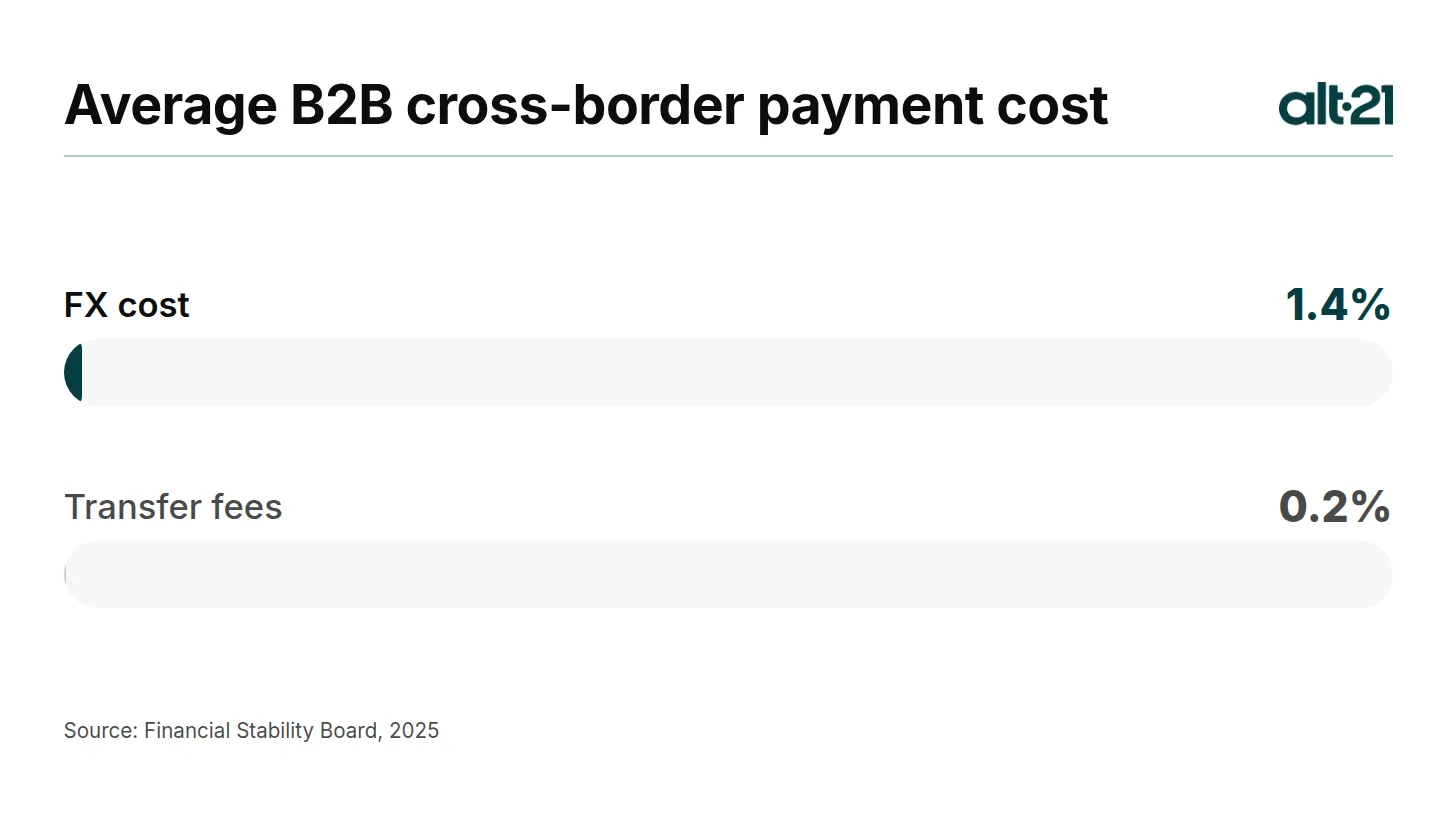
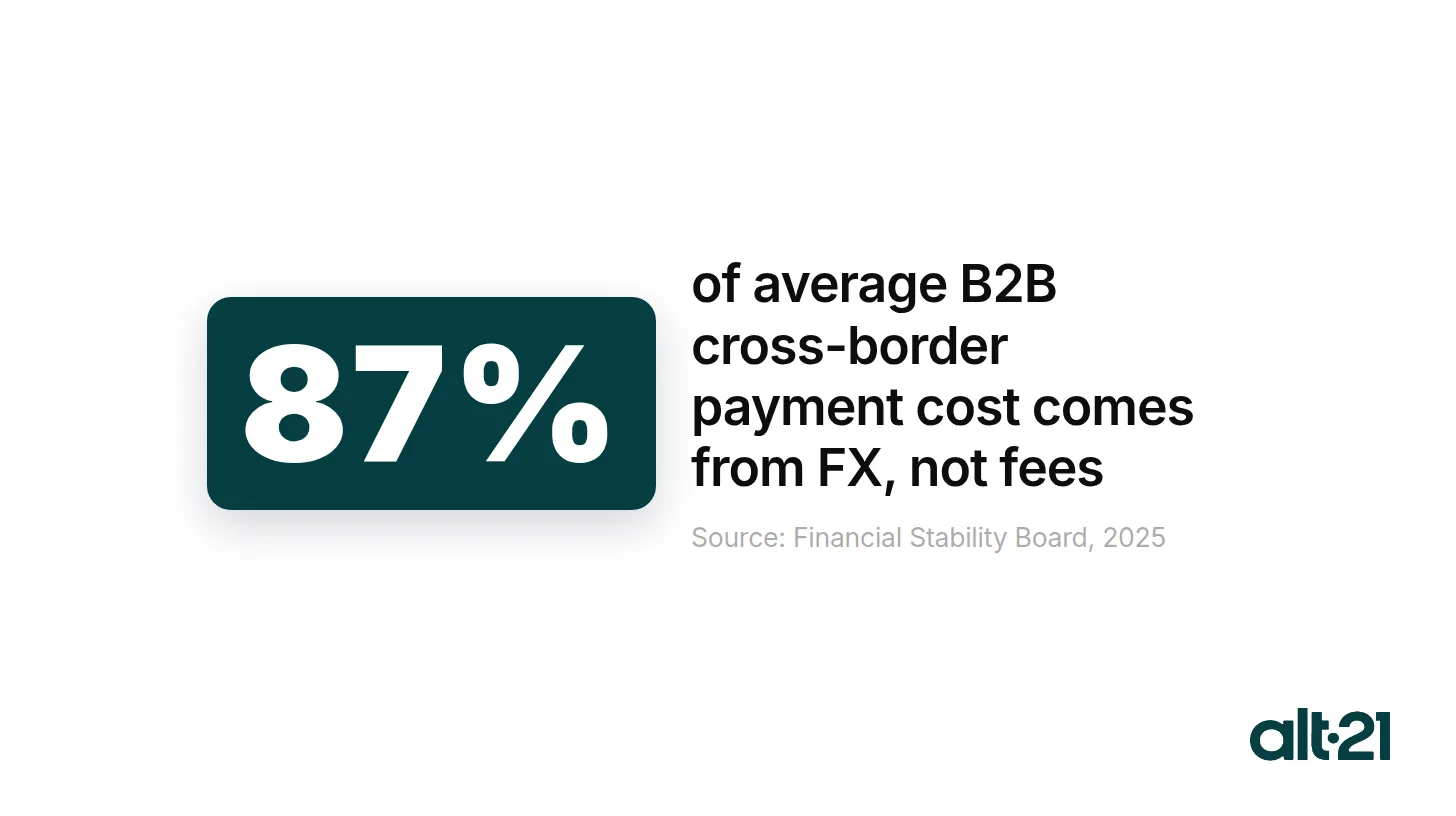
The Financial Stability Board’s 20253 data show how large that difference can be. For B2B cross-border payments, the average FX cost was 1.4% of the payment amount, compared with 0.2% in fees. FX therefore accounted for 87% of the average cost.
The reason is easy to miss. A transfer fee is usually shown as a separate charge. An FX margin can be built into the exchange rate you are offered, so you may need to compare that rate with the underlying market rate to see the difference.
The FCA4 has also highlighted this problem. In its 2025 guidance on international payment pricing, it described advertising a payment as zero-cost because there is no fixed fee, while charging a markup through the exchange rate, as poor practice.
How to compare providers properly
When comparing providers, check the same payment at the same time and look at:
- The exchange rate and any margin included in it
- The transfer fee
- Any expected intermediary or recipient-bank fees
- The amount your supplier is expected to receive
3. Budgeting a future payment using today’s exchange rate
If you agree today to pay a supplier in euros three months from now, you already know how many euros you’ll need. What you don’t know is how many pounds those euros will cost when the payment is due.
If you’re planning a future FX payment, you might build your budget around today’s exchange rate. That can make budgeting difficult. The rate can move before the payment date, which means the final sterling cost can be higher or lower than you planned.
For illustration only, and not a forecast or current rate, a €500,000 payment would cost about £438,600 at a GBP/EUR rate of 1.14 and about £423,700 at 1.18. That is a difference of almost £15,000 for the same euro payment.
What you can do instead
If you know how much foreign currency you’ll need, you can consider managing that exposure in advance.
One commonly used option is a forward contract. It lets you agree on an exchange rate today for a specified amount of currency to be exchanged at a later date. That gives you more visibility over what the future payment will cost and can make budgeting easier.
A forward contract is a binding commitment, so it is generally more suitable when you are confident about how much currency you need and when you need it. If the amount or timing could change, committing in advance may be less suitable. If you already know roughly how much foreign currency you’ll need and when, a forward contract is one option some businesses consider. If the amount or timing could still change, committing in advance may be less suitable.
Important information/risk warning:
Forward contracts create a binding obligation to exchange currency at an agreed rate on a future date, even if your plans change. If exchange rates move in your favour, you won’t benefit from that movement on the amount covered by the contract.
Forward contracts may involve margin or collateral requirements, and carry counterparty and settlement risk. They may not be suitable for every business, and their suitability will depend on your circumstances, objectives and currency exposure. You may wish to take independent advice before entering into any FX product.
4. Ignoring bank holidays and cut-off times
A working day on your calendar isn’t always a working day for the payment.
Your provider will usually have a cut-off time for each payment route or currency. If you submit the payment after that time, it may not be sent until the next business day.
The calendar can cause another delay. Your office may be open while the settlement system involved in the payment is closed.
T2, the Eurosystem’s settlement system for large-value euro payments, operates Monday to Friday and closes on 1 January, Good Friday, Easter Monday, 1 May, 25 and 26 December.
This can create dates that are easy to miss. For example, 1 May is always a T2 closing day, even when it is a normal working day in the UK.
Alt21’s cut-off times and payment timings are indicative and can vary by currency, route and receiving bank.
The Financial Stability Board reported in 2025 that real-time gross settlement (RTGS) systems still typically operate only on weekdays, although more are moving towards extended or 24/7 operating hours.
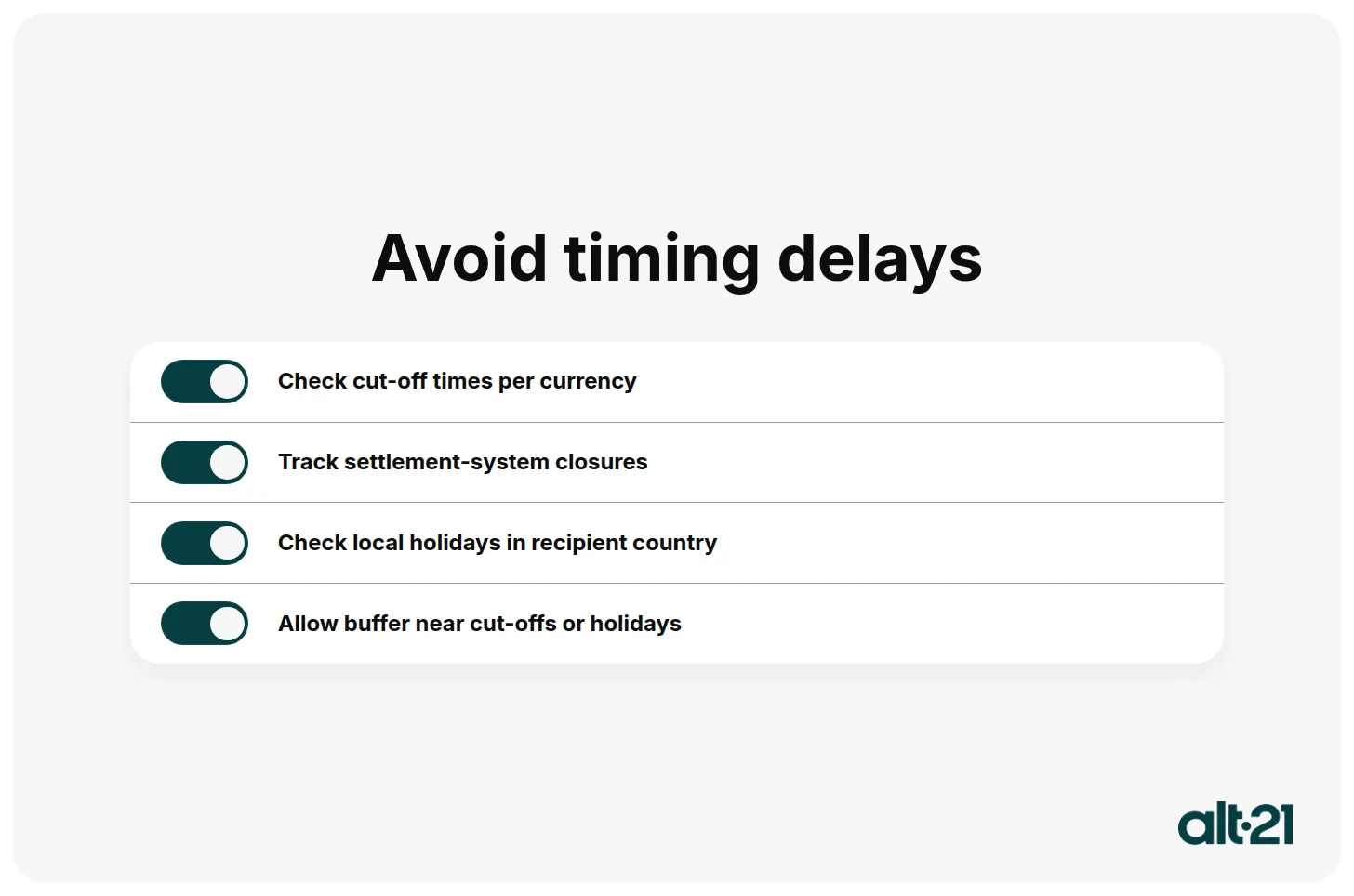
How to avoid timing delays
- Check your provider’s cut-off time for each currency or payment route you regularly use.
- Keep track of bank holidays and settlement-system closing days that affect those payments.
- Check local holidays in the recipient’s country when timing matters, especially for payroll or supplier deadlines.
- Allow extra time when a payment falls close to a cut-off time, weekend or holiday.
5. Accepting slow, opaque payments as “just how it works”
If a supplier payment is late once, there may be a straightforward reason. If payments through the same route are late every month and your team keeps asking where the money is, that is worth investigating.
According to the Financial Stability Board’s (FSB) 2025 data for services sending business-to-business and business-to-person payments from Europe and Central Asia, around 5% reported crediting funds within an hour and about 67% within one business day. These figures are industry-wide and do not describe Alt21’s service.
One common source of delay is the final part of the payment journey. After the receiving provider gets the payment instruction, there can still be a gap before the money reaches your supplier’s account.
This stage is known as the beneficiary leg, and the FSB says it has traditionally been the slowest part of a cross-border payment.
The cause may sit further along the payment chain and outside your provider’s direct control. Even then, you should still be able to understand where the payment is, what may be holding it up and whether the same problem keeps happening.
You may wish to ask your provider what payment status information it can give you.
When to question recurring delays
Look for patterns across several payments rather than judging one late transfer in isolation.
- Track which currencies and payment routes are regularly late.
- Check whether delays tend to happen at the same stage.
- Ask what payment-status information your provider can give you while the transfer is in progress.
- If your team keeps chasing the same payments, ask what’s causing the delay and whether another route or process could improve it.
6. Leaving compliance checks and payment documents until the last minute
A payment can be ready to send and still get held because one document or piece of information is missing.
There are strict regulatory and legislative requirements for all payments made by UK financial firms. Additional due diligence checks and additional information requests may be made before a payment is processed, which can affect timing.
This matters more in payment routes where additional checks or supporting documents are required. An IMF and Financial Stability Board analysis of corridors with capital controls found that incomplete supporting documentation can delay credit to the beneficiary by hours or even days.
The problem can be something simple. An authorised signatory’s ID has expired. The supplier name on the invoice doesn’t match the name on the bank account. Or the payment is missing a required purpose-of-payment reference.
Payment information requirements are also becoming more structured. In June 2025, the FATF revised Recommendation 165, which sets requirements for the information that should accompany payments. Countries are expected to be ready to implement the revised requirements by the end of 20306.
What to check before payment day
- Make sure signatory IDs and authorisation records are still valid.
- Check that the supplier’s legal name matches the name on their bank account.
- Find out whether the payment route requires a purpose of payment.
- Keep invoices and other supporting documents ready when they may be requested.
7. Not reviewing your setup as your payment needs change
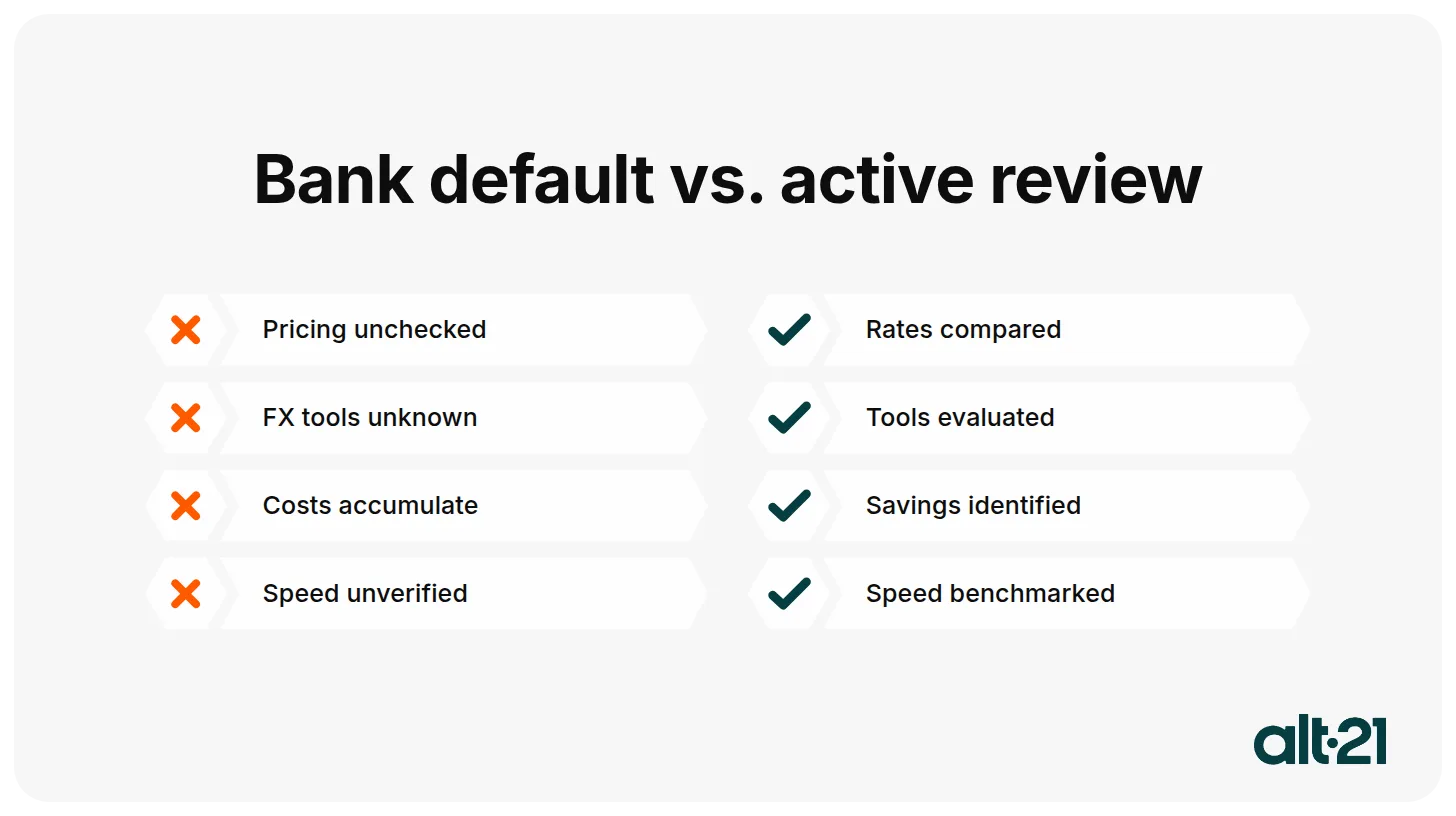
Using the same bank for international payments can be convenient. If you’ve used that setup for years, you may not know how its pricing, speed or FX tools compare with other options.
The differences can look small on one payment. Across a year of supplier payments, exchange-rate and fee differences can add up quickly.
Your needs can also change over time. A business that once needed only occasional international payments may later be managing regular supplier invoices, payroll in several currencies or future FX exposure.
A bank relationship can still be valuable for areas such as credit and account management. It’s worth reviewing the international payments side separately as those needs become more complex.
How to review your current setup
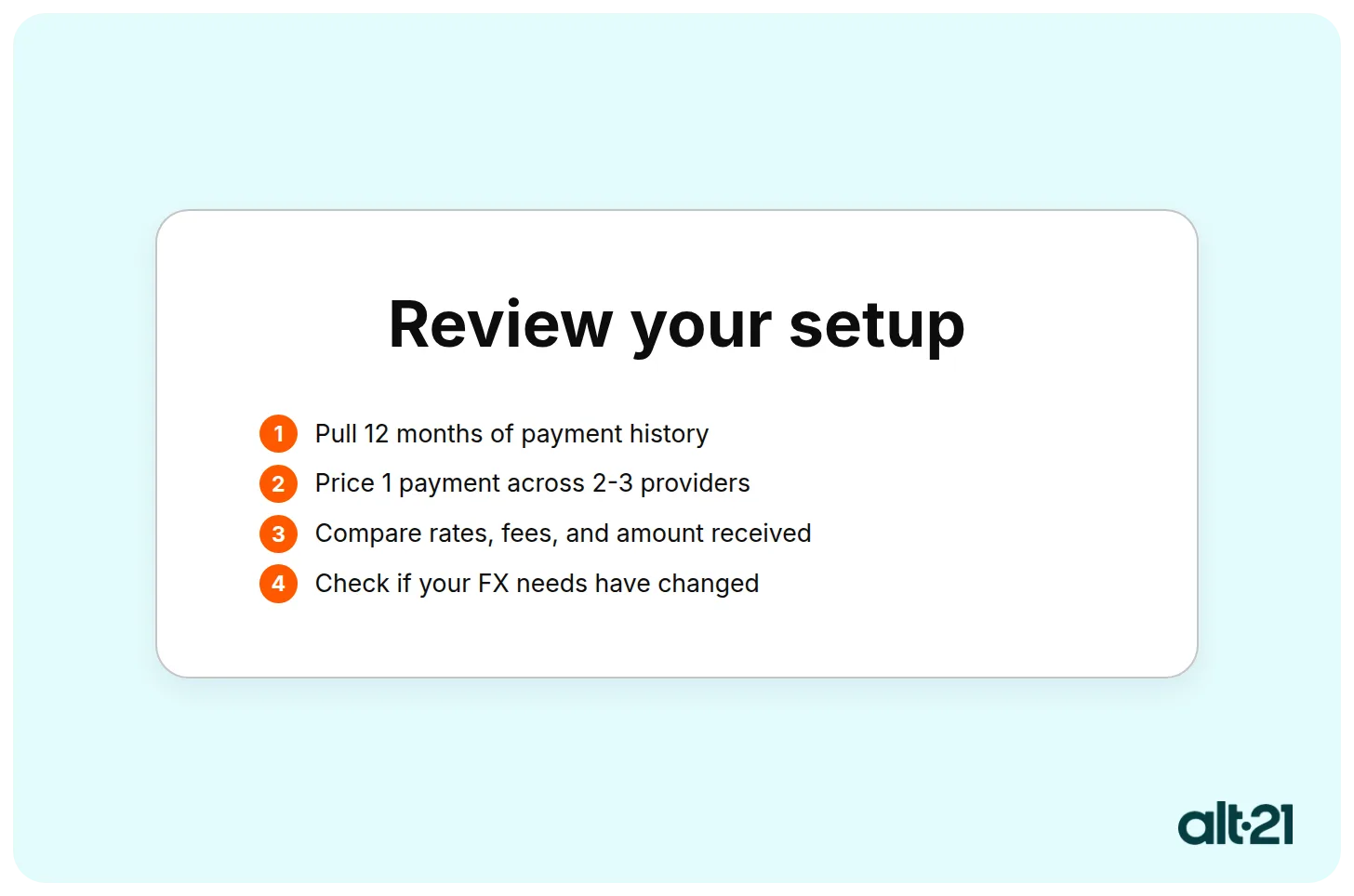
- Pull your international payments from the last 12 months and review the exchange rates and fees you paid.
- Take one typical payment and price the same amount with two or three providers at roughly the same time.
- Compare the exchange rate, FX margin where it is disclosed, transfer fees and the amount the supplier is expected to receive.
- Compare how long the payment is expected to take and what tracking information you get while it is in progress.
- Check whether you now need tools you did not need when you chose your current provider, such as ways to plan or manage future currency exposure.
International payments are often where these problems first become visible. As payment volumes grow, it becomes more valuable to understand what each payment costs before you confirm it.
Alt21 offers international payments and tools for planning future currency needs, including forward contracts, on one platform. Forward contracts are a binding commitment and carry risks, including those set out above, so they are not suitable for every business.
Whether Alt21 is the right fit will depend on your business’s needs and circumstances, and eligibility criteria and terms and conditions apply. Please read the full disclaimer at the bottom of the page.
Ready to review your current setup? Open an Alt21 account and see whether it fits your international payment needs.
FAQ (Frequently asked questions)
What are the most common mistakes businesses make with international payments?
Some of the most common mistakes are using unverified beneficiary details, focusing only on transfer fees, missing payment deadlines, and preparing required documents too late. These problems can lead to delays, unexpected costs or additional admin.
Why is comparing international payment providers by transfer fee a mistake?
The transfer fee is only one part of the total cost. FX margins can be built into the exchange rate, and intermediary or recipient-bank fees may also apply. Compare the exchange rate, fees and expected amount received for the same payment at roughly the same time.
Why should businesses regularly review their international payment provider?
Your payment needs can change as the business grows. A provider that worked well for occasional payments may be less suitable once you are handling regular supplier payments, multiple currencies or future FX exposure. Reviewing pricing, speed, visibility and available FX tools helps you see whether your current setup still fits.
Alt21 Limited is authorised and regulated by the Financial Conduct Authority (FRN: 783837) and is a company registered in England and Wales (number 10723112). The registered address is 45 Eagle Street, London WC1R 4FS, United Kingdom. This article has been produced by Alt21 Limited for information purposes only. It does not constitute financial advice or an offer to sell or the solicitation of an offer to buy any products referenced. Hedging products are not suitable for every business. Before entering into any FX product, you should consider whether it is appropriate for your needs and circumstances. Alt21 Limited assumes no liability for errors, inaccuracies or omissions. Eligibility criteria and terms and conditions apply to all products and services offered by Alt21 Limited. Not all applications will be accepted.
- https://www.europeanpaymentscouncil.eu/what-we-do/other-schemes/verification-payee
- https://www.alt21.com/new-releases/
- https://www.fsb.org/uploads/P091025-1.pdf
- https://www.fca.org.uk/publications/good-and-poor-practice/consumer-duty-international-payment-pricing-transparency-good-poor-practice
- https://www.fatf-gafi.org/content/dam/fatf-gafi/annual-reports/fatf-annual-report-2024-2025.pdf
- https://www.fatf-gafi.org/content/dam/fatf-gafi/recommendations/Explanatory%20Note%20for%20Revised%20R.16.pdf.coredownload.pdf