



This article is provided by Alt21 Limited, trading as Alt21, an FCA authorised payments and FX provider and is intended for UK businesses considering FX hedging as part of their treasury activity. All examples provided are illustrative only and not a current or guaranteed rate. FX hedging products carry risk, including the risk that rates move against you and that you may be asked to provide collateral at short notice, which could affect your cash flow. Comments from Pritesh Ruparel, Group Chief Executive Office (CEO) of Alt21 and Tom Vooght, Head of Sales at Alt21 are contained within the article. As Alt21 employees, their comments reflect their own experience working with Alt21’s clients and describe Alt21’s own products and approach, rather than independent market commentary. Please read the full disclaimer at the bottom of the page.
Your supplier in Rotterdam says the money hasn’t landed. Your bank portal shows it was sent on Tuesday, and someone on your finance team is now refreshing the screen. An international payments API can help close that visibility gap by connecting your systems directly to a payment provider.
In this article, we’ll cover how international payments APIs work in practice and what matters when choosing a provider.
What is an international payment API?
An international payments API is a direct connection between your software and your payments provider. It lets your systems send payment instructions and receive updates without someone logging into a separate portal.
API stands for application programming interface. It’s a standard way for two software systems to exchange information.
For example, your accounting system could send an instruction to pay a supplier €40,000 and receive a payment reference and status in return.
International payments add another layer:
A payment within the UK can move in pounds through a domestic network such as Faster Payments. A payment to a Dutch supplier in euros may also involve currency conversion and a different payment network, such as SEPA (Single Euro Payments Area).
Some providers can route international payments through local payment networks in each country, while others may use correspondent banks or SWIFT. The route depends on the currencies, countries and provider.
That means an international payments API may need to handle:
- The exchange rate: This includes the rate applied to the conversion and, where disclosed, the provider’s margin.
- Bank details in the local format: A Dutch supplier may use an IBAN, while a US recipient may need a routing number and account number.
- Payment status updates: Cross-border payments can involve several stages or financial institutions, so your system may receive updates as the payment moves towards the recipient.
How do FX payment APIs work?
A typical foreign exchange (FX) payment API flow has five steps:
1. Quote
Your system requests a rate for a currency pair and amount. The response gives you the rate, how long the quote is valid and, where disclosed, the provider’s margin.
2. Instruct
You send the payment amount, the recipient’s bank details and a reference you can later use to match the payment against your ledger.
3. Fund
The provider needs to receive the money before it can send the payment. You can use money already held in your account with the provider or transfer the required amount to them.
4. Validate and settle
The provider checks the payment, converts the currency where needed and sends the funds through the appropriate payment network.
5. Report back
Status updates can return through webhooks. These are automatic messages the provider sends to your system when something changes, so your team doesn’t have to check the status manually.
Before integrating, check that the provider offers a sandbox. This is a test version of the API that moves no real money. You should also check how the provider protects access to the API and verifies the updates it sends to your system.
For example, Alt21 provides a sandbox for partners to test payments, FX conversions and webhook events before going live. Its live API uses encrypted connections and additional authentication options for larger integrations. It also verifies webhook updates so your system can check that they genuinely came from Alt21.
(All applicants must pass Alt21’s robust onboarding processes and accept terms and conditions before becoming a client.)
Why should your business use international payments APIs?
An international payments API can improve payment visibility, reduce manual work, and bring reconciliation data into one place.
See where your payments are
An API can bring payment updates directly into the systems your team already uses. You can see what has been sent, completed or delayed without checking another portal.
This is the kind of manual work Pritesh Ruparel, CEO of Alt21, expects technology to remove from finance teams:
‘Chasing a provider for a statement, or asking where a payment is – that’s the stuff technology should be handling, not people.’
The Financial Stability Board’s 2025 progress report 1 found that only 39.6% of B2B retail cross-border payment services in its sample could credit recipients within one business day. For payments sent from Europe and Central Asia, around 67% could do so within a day.
Make reconciliation easier
Payment references and settlement data can flow back into your accounting or enterprise resource planning (ERP) system. This makes it easier to match payments against invoices and ledger entries.
Reduce manual payment work
An API can send payment instructions directly from your accounting or ERP system, reducing the need to enter payments one by one or copy IBANs, account numbers and other details between tools.
This becomes more useful as recurring supplier or contractor payment volumes grow.
Types of international payment APIs
An API for international payments can focus on different parts of the payment process. The ones you need depend on what your business is trying to automate.
Payout APIs
Send money to suppliers, contractors or employees in other countries. For businesses mainly sending money out, this can be a practical place to start.
Collection APIs
Receive money from customers, often through local account details. A customer in Germany, for example, may be able to pay into a local euro account rather than make an international transfer.
FX APIs
Get live exchange rates and convert currencies programmatically. Some providers, including Alt21, also let businesses book forward contracts through the API.
Data and reporting APIs
Pull balances, transaction history and settlement information into your own systems. These can be particularly useful for reconciliation and month-end reporting.
Open banking APIs
Start payments directly from a bank account. In the UK, this is covered by Open Banking rules. In the EU, PSD2 sets similar payment rules.
The useful question is not how many API types a provider offers, but which parts of your payment process you want to connect.
If you only make occasional euro supplier payments, a payout API may be enough. If you regularly receive or pay in several currencies, you may also need FX tools for managing future exchange rates.
Examples of cross-border payment API providers
Choosing an international API payments platform often comes down to what it offers alongside the payment itself. Some focus on checkout or payouts, while others combine payments with FX and currency management.
Currency management platforms
Alt21 combines international payments with FX and currency management. The API gives partners programmatic access to payments, FX rates, currency conversion, forward contracts and settlement data.
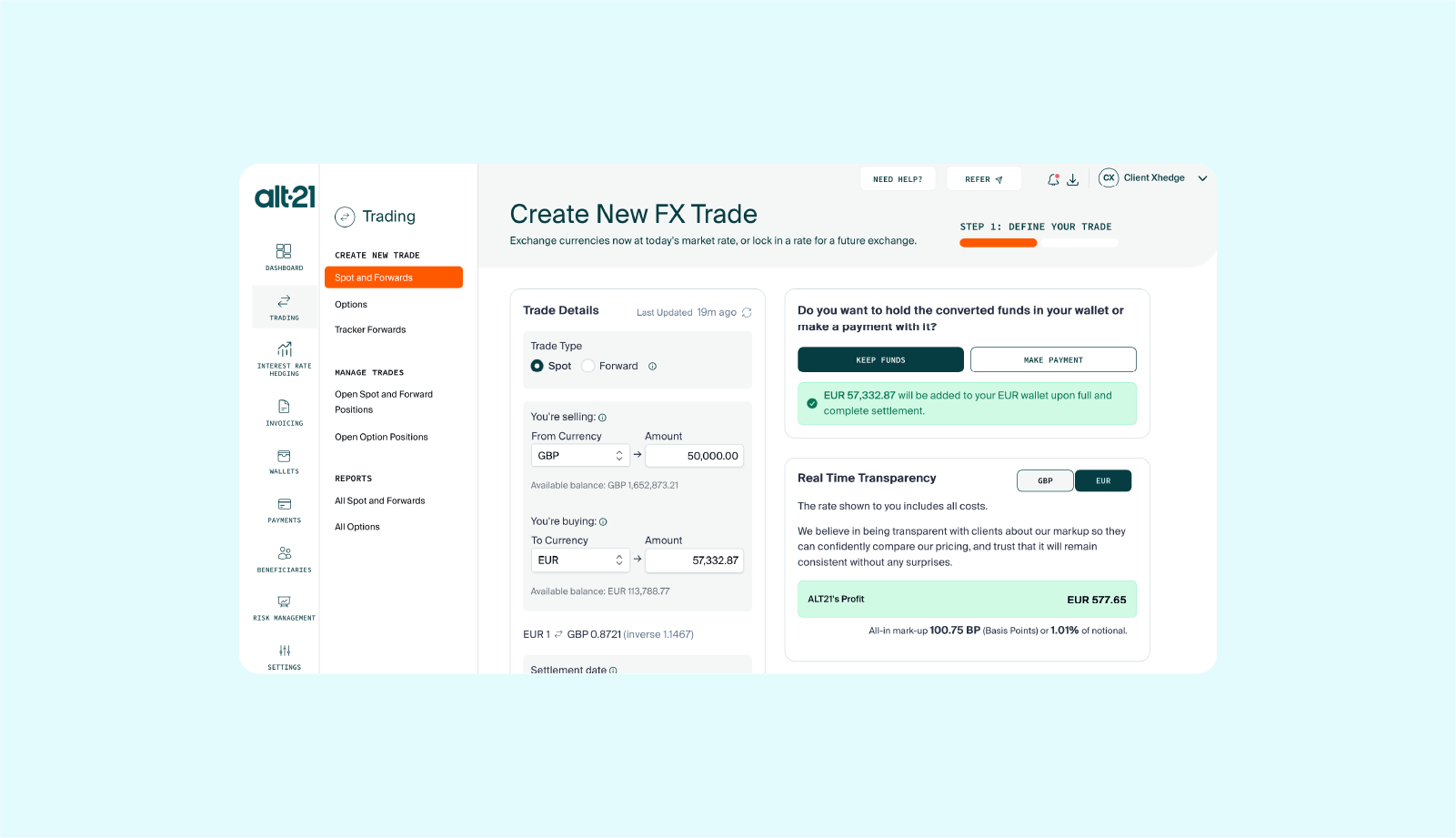
This allows partners to integrate FX, hedging and payment capabilities into their own platforms and services, making them available to their clients.
Card and checkout platforms
The Stripe international payments API 2 is built around online payments and commerce. It supports payments in more than 135 currencies, while its payout products let businesses send money to recipient bank accounts in supported markets.
This makes it particularly relevant when international money movement starts with an online checkout or sits inside a broader Stripe payment setup.
Wallet networks
The PayPal international payments API includes its Payouts API, which supports recipients in over 156 countries and more than 23 currencies.3
It’s commonly used for contractor and marketplace payouts where recipients already use PayPal and prefer to be paid that way.
Payment infrastructure providers
The Wise platform gives banks and technology companies access to Wise’s international payment network. It supports more than 40 currencies and connects directly to domestic payment systems in eight markets.
Its API is designed for businesses that want to build international payments into their own products or financial workflows.
Banks and SWIFT-based providers
Your existing bank may also offer an API or another direct system connection for international payments.
The main advantage is reach, since SWIFT connects banks across a large number of markets. The level of payment tracking, FX pricing information and automation can vary between banks, so these are worth comparing before you integrate.
Potential challenges of using a cross-border payment api
A cross-border payment API can remove a lot of manual work, but the integration still comes with a few practical challenges.
Here are the most common ones to plan for before you go live:
Integration involves more than connecting the API
An API integration for international payments involves more than connecting your ERP or accounting software to a provider. You need to map supplier records to the provider’s format, set approval rules and decide how to handle failed or delayed payments.
It’s also worth checking whether the provider already has a connector for the software you use. A prebuilt connection can reduce the amount of custom development required.
Your payment data has to be clean
An API can only work with the information you give it. If supplier names, addresses or bank details are incomplete or stored inconsistently, those problems can carry into the payment workflow.
This matters even more as payment messaging standards become stricter. ISO 20022 is now used for cross-border payment instructions on the SWIFT network. From 14 November 2026, SWIFT will reject cross-border payment messages 4 that contain fully unstructured postal addresses.
If your supplier records still keep addresses in a single free-text field, this is worth reviewing before you integrate.
Compliance checks still apply
Automating a payment doesn’t remove the checks that payment providers have to perform.
Since 9 October 2025, euro-area payment providers have had to offer Verification of Payee 5 under the EU Instant Payments Regulation. This checks whether the payee name matches the IBAN before a credit transfer is sent.
Other compliance checks also remain part of the payment process. An API can automate how information moves between your systems and the provider, but it does not bypass the rules underneath.
An API does not remove FX costs
An API can give you better access to pricing information, but it does not automatically make the FX margin smaller.
The Financial Stability Board 6 found that FX costs remain the largest single component of cross-border payment costs. If a provider shows its FX margin or fee in the quote, an API can bring that information directly into your own system so your team can see the cost before confirming the payment.
It is also worth checking for charges outside the FX quote. The FSB’s 2025 survey found that receiver-side costs ranged from 0.1% to 1.3% of the amount sent.
Transparency should go beyond pricing. If you use other FX products alongside payments, you also need to understand any credit or collateral requirements and the conditions attached to them.
As Tom Vooght, Head of Sales at Alt21, puts it:
‘It shouldn’t just be that your provider shows you the price. It should be that you can see what happens to your money at every stage, not just the FX quote.’
Hedging products such as forward contracts carry risk; you may be asked to provide collateral, and if the market moves in your favour after you have hedged, you will not benefit, since you remain locked into the agreed rate.
Should your business use an international payments API?
An API tends to earn its place when manual payment work starts taking up too much time or creating gaps between systems. It may be worth considering if:
- Payment volumes are growing and entering payments manually is becoming time-consuming.
- Your team spends too much time reconciling payments across different systems.
- You regularly need to check payment status in a separate portal.
- Payment data has to be copied manually between your accounting software, spreadsheets and payment provider.
- You want payment and FX data to flow directly into the systems your team already uses.
You don’t necessarily have to automate everything at once. You could begin with the part of the workflow creating the most manual work, such as pulling settlement data into your accounting system, then expand the integration as your needs grow.
Alt21 gives businesses in the UK and selected European markets one platform for international payments and FX, with reconciliation built in. You can use it through the dashboard or, if you’re a partner, the API.
ALT21 Limited is authorised and regulated by the Financial Conduct Authority (FRN: 783837) and is a company registered in England and Wales (number 10723112). The registered address is 45 Eagle Street, London WC1R 4FS, United Kingdom. This article has been produced by ALT21 Limited for information purposes only. It does not constitute financial advice or an offer to sell or the solicitation of an offer to buy any products referenced. Hedging products are not suitable for every business. Before entering into any FX product, you should consider whether it is appropriate for your needs and circumstances. ALT21 Limited assumes no liability for errors, inaccuracies or omissions. Eligibility criteria and terms and conditions apply to all products and services offered by ALT21 Limited. Not all applications will be accepted.
- https://www.fsb.org/uploads/P091025-1.pdf
- https://docs.stripe.com/currencies
- https://developer.paypal.com/payouts/faqs
- https://www.google.com/url?q=https://www.swift.com/standards/iso-20022/removal-unstructured-address&sa=D&source=docs&ust=1789380956366459&usg=AOvVaw2vxPFwWen5wSOn88K2T_sb
- https://www.europeanpaymentscouncil.eu/what-we-do/other-schemes/verification-payee
- https://www.fsb.org/uploads/P091025-1.pdf