

This guide is provided by Alt21 Limited, an FCA authorised payments and FX provider. All examples provided are illustrative only and not a current or guaranteed rate.
Every international business faces currency risk, but that doesn’t mean it has to be left to chance. Whether you’re paying overseas suppliers, invoicing international customers or planning next quarter’s budget, exchange rate movements can quietly influence your costs, profit margins and cash flow.
The good news?
With the right FX risk management strategy, you can build greater control and visibility over currency risk – even if you can’t remove it entirely.
In this guide, we’ll explain what FX risk management is, the different types of foreign exchange risk businesses face, and the practical strategies treasury professionals use to protect against currency volatility and plan for sustainable growth.
Quick summary
- FX risk management helps businesses trading internationally manage the impact of currency movements on profit margins, improve cash flow forecasting and create better visibility around future costs.
- Currency risk depends on how you sell, buy and operate across markets. Types include: transaction, translation, economic and liquidity risk.
- Factors that may influence FX risk are: international trade, delayed payment terms, operating in multiple currencies, market volatility, lack of forecasting and no formal FX policy.
- Currency forecasting, an FX policy, diversifying currency exposure, improving treasury visibility, using hedging, and investing in the right technology are all techniques for managing FX risk.
- The common strategies for managing FX risk include forward contracts, FX options, currency diversification, treasury management systems, and regular strategy reviews.
What is FX risk management?
FX risk management is the process of identifying, assessing and reducing the impact that exchange rate movements can have on a business’s finances. It helps businesses trading internationally manage the impact on profit margins, support cash flow forecasting and improve visibility over future costs.
Whenever a business buys goods from overseas, invoices customers in another currency, or holds funds in foreign currencies, it’s exposed to fluctuations in exchange rates. If those rates move unexpectedly, the business could end up paying more than planned or receiving less revenue than expected.
For example, imagine a UK manufacturer agrees to pay a European supplier €250,000 in 90 days. If the pound weakens against the euro before the invoice is due, the business could pay thousands of pounds more than what they originally budgeted-despite the invoice amount remaining the same.
Rather than reacting to currency movements after they’ve happened, businesses use FX risk management strategies to reduce uncertainty and improve financial planning.
These strategies may include forecasting future currency requirements, setting risk policies, monitoring market movements and using hedging solutions to protect against adverse exchange rate fluctuations.
Keep in mind that FX risk management is not a tool to predict the market. Organisations use it to assist in making financial decisions because it helps them understand where currency exposure exists and where to implement appropriate controls. This way, finance teams spend less time focusing on exchange rate volatility and more on supporting long-term business growth.
Typical types of FX risk
The first step towards building an effective FX risk management strategy is to understand the different types of FX risk.
The following types of currency risk depend on how you sell, buy and operate across markets.
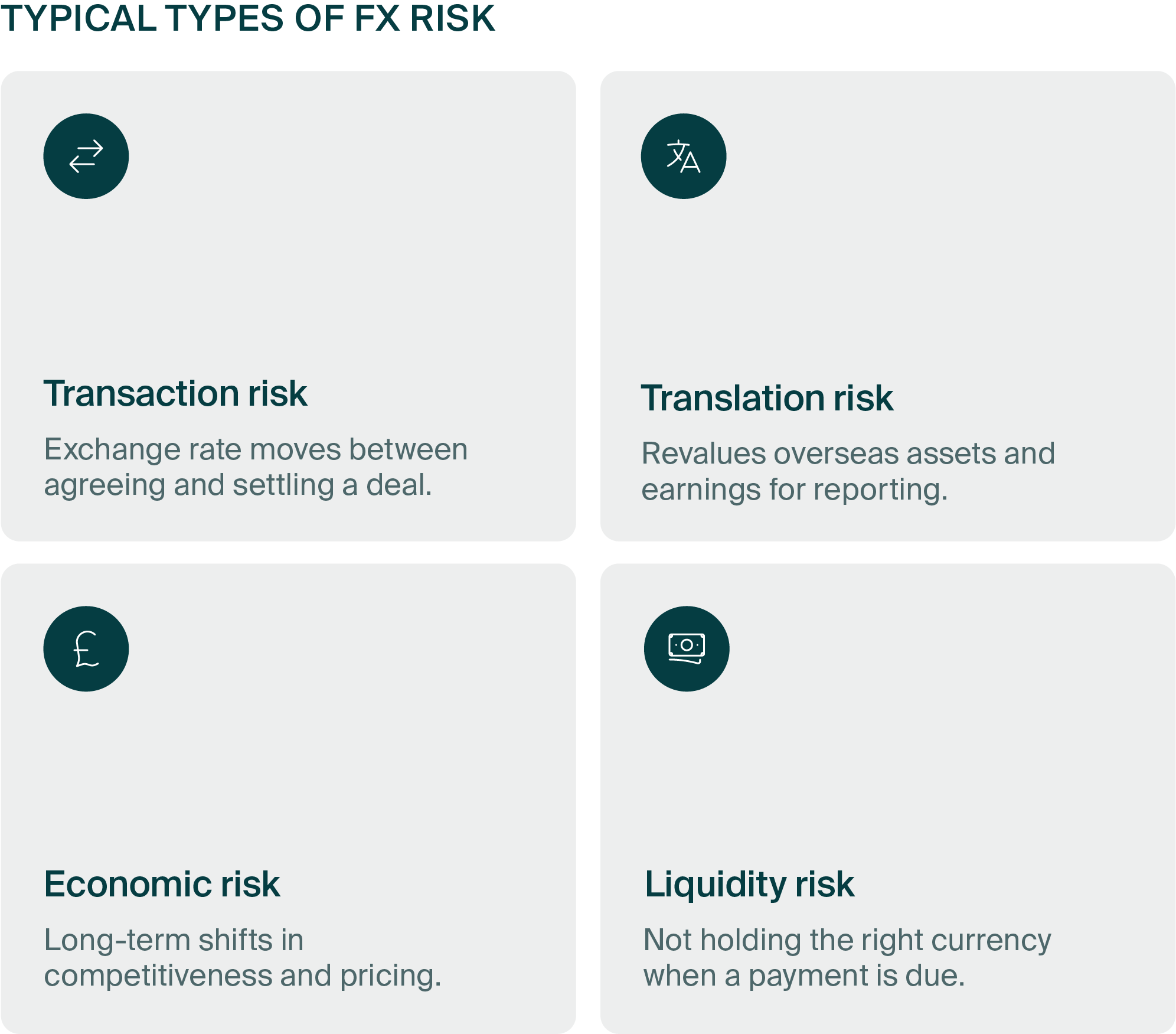
Transaction risk
Transaction risk is the most common type of foreign exchange exposure. It occurs when a business agrees to buy or sell goods in a foreign currency, but the exchange rate changes before payment is made.
For example, a UK importer orders products from a supplier in Germany with payment due in 60 days. If sterling falls against the euro before the invoice is settled, the business will pay more in pounds than originally expected.
This type of risk has a direct impact on operating costs and profit margins.
Translation risk
Translation risk, also sometimes called accounting risk, affects businesses with overseas subsidiaries or assets denominated in foreign currencies.
Although no money may actually change hands, fluctuations in exchange rates can alter the value of overseas assets, liabilities and earnings when they’re converted into pounds for financial reporting.
While this type of exposure doesn’t always affect cash flow immediately, it can influence reported financial performance and balance sheets.
Economic risk
Economic risk is the long-term impact that currency movements can have on a company’s competitiveness and future profitability.
For example, if sterling strengthens significantly, UK exporters may become more expensive to overseas customers, making their products less competitive compared to local suppliers.
Unlike transaction risk, which relates to individual payments, economic risk affects the wider commercial strategy of a business and often requires ongoing monitoring and forecasting.
Liquidity risk
If you’re operating across multiple currencies, you may experience liquidity risk if you don’t have access to the right currency when payments become due.
Unexpected exchange rate movements or poor cash flow planning can leave finance teams converting funds at unfavourable rates simply to meet payment deadlines.
Holding multiple currencies or improving treasury visibility can help reduce this type of exposure.
Which type of FX risk matters most?
Transaction risk is typically the most immediate day-to-day challenge for SMEs and mid-market businesses because it directly affects supplier payments, customer receipts and cash flow. However, with international expansion, translation and economic risk become increasingly important considerations for finance and treasury teams.
Understanding where your business is exposed allows you to prioritise FX risk management strategies suited to your business, rather than taking a one-size-fits-all approach.
Six reasons why FX risk happens
It’s impossible for a business to control the FX market – it’s constantly changing, with exchange rates rising and falling in response to global markets. What you can do is stay prepared for any market volatility. (More on how to do this later on in this article.)
Here are the factors that influence FX risk that you should stay on top of:
| Strategy | What it does | Best suited for | Trade-off |
| Forward contracts | Agrees an exchange rate today for a future payment | Businesses with known payment dates and amounts | Creates a binding obligation, even if rates later move in your favour |
| FX options | Gives the right, but not the obligation, to exchange at an agreed rate | Businesses with uncertain payment timing or amounts | Requires a non-refundable upfront premium |
| Currency diversification | Holds funds across multiple currencies to reduce conversions | Businesses with regular overseas income and outgoings | Doesn’t remove exposure, just reduces conversion frequency |
| Treasury management systems | Centralises visibility over exposure, cash flow and hedging activity | Businesses managing several currencies or complex operations | Adds a system to implement and maintain |
| Regular strategy reviews | Reassesses the FX approach as the business and markets evolve | Businesses with changing suppliers, markets or exposure | Requires ongoing time and attention rather than a one-off setup |
This guide is provided for general information and does not constitute financial advice or a personal recommendation. Forward contracts and FX options are risk management tools, not risk-free solutions. Forward contracts create a binding obligation to transact at the agreed rate, may require margin payments, and remove the ability to benefit if exchange rates move in your favour before settlement. FX options involve a non-refundable upfront premium and are more complex instruments that may not suit every business. All hedging strategies carry the risk that the currency markets move in a direction that would have been more favourable without the hedge in place. Whether any FX risk management strategy is appropriate depends on your business’s individual circumstances, and you should consider this carefully – or seek independent advice – before entering into any FX product.
1. Trading internationally
Every time a business buys from or sells to another country, it creates exposure to currency fluctuations.
The longer the gap between agreeing a price and making or receiving payment, the greater the potential impact of exchange rate movements.
2. Delayed payment terms
Many international contracts include payment terms of 30, 60 or even 90 days.
During that period, exchange rates can move significantly, causing the final cost or value of the transaction to differ from the original budget.
3. Operating in multiple currencies
As businesses grow internationally, they often receive revenue in one currency while paying suppliers or employees in another.
Managing several currencies simultaneously increases both operational complexity and foreign exchange exposure.
4. Market volatility
Exchange rates respond to a wide range of external factors, including:
- Interest rate decisions
- Inflation
- Economic growth
- Political events
- Geopolitical uncertainty
- Global trade policies
- Market sentiment
These factors can cause currencies to fluctuate rapidly, sometimes within hours.
5. Lack of forecasting
Many businesses don’t identify their currency exposure until an invoice is due. Without forecasting future foreign currency requirements, finance teams have little opportunity to plan or reduce unnecessary risk.
Businesses that forecast upcoming payments and receipts are generally better positioned to make informed decisions about currency management rather than reacting to market movements at the last minute.
6. No formal FX policy
One significant reason businesses may experience unnecessary FX risk is the absence of a structured approach.
Without a documented FX risk management framework, decisions are often made on an ad hoc basis.
One month a payment is converted immediately; the next it’s delayed in the hope that exchange rates improve. This inconsistency can make budgeting difficult and expose the business to unnecessary volatility.
A clear policy helps finance teams define when to exchange currencies, when to consider corporate FX hedging and how much currency exposure the business is willing to accept.
Practical techniques for effective FX risk management
There’s no single solution to managing currency risk. Businesses usually combine forecasting, treasury planning and hedging to create a strategy that reflects their commercial objectives and risk appetite.
The FX risk management strategy you choose should depend on factors such as your trading volumes, cash flow, international markets and tolerance for exchange rate volatility. These strategies are not a way to predict currency movements; rather, they help finance teams improve financial visibility.
Here are some of the techniques commonly used by treasury professionals.
Forecast future currency exposure
You can’t manage what you can’t see.
One way to help manage FX risk is to forecast future foreign currency requirements. By identifying upcoming supplier payments, customer receipts and overseas expenses, finance teams can gain a clearer picture of their currency exposure before it affects the business.
Forecasting also helps businesses:
- Improve budgeting visibility
- Plan cash flow with greater confidence
- Identify potential FX exposure earlier
- Make more informed hedging decisions
Create an FX policy
Many businesses rely on instinct when making foreign exchange decisions. A documented FX risk management framework creates consistency by defining:
- Which currencies are monitored
- Acceptable levels of FX exposure
- When hedging should be considered
- Approval processes
- Reporting responsibilities
Having clear policies helps remove emotion from decision-making and ensures a consistent approach across the business.
Diversify currency exposure
Businesses operating in multiple markets may be able to reduce overall exposure by balancing revenues and expenses across different currencies.
For example, receiving euros from customers while paying European suppliers in euros can naturally reduce the need for frequent currency conversions.
Improve treasury visibility
As international operations become more complex, visibility becomes increasingly valuable.
FX forecasting and risk management systems may assist finance teams with greater oversight of future obligations, cash positions and currency exposure, making it easier to make proactive decisions instead of reacting to market movements.
Use hedging where appropriate
You don’t need to hedge every international payment, but when businesses have known future currency obligations, hedging FX risk can provide greater visibility. This may include reducing the impact of adverse exchange rate movements.
Common corporate FX hedging solutions include forward contracts, FX options and other treasury tools that allow businesses to manage future exchange rate exposure more effectively.
You may also be interested in reading our guide on dynamic hedging.
The most appropriate approach for your business depends on your commercial objectives, cash flow requirements and overall risk management strategy.
Invest in supporting technology
FX risk management technology supports finance teams in monitoring currency exposure, automating reporting, improving forecasting and making more informed treasury decisions from a single platform.
This tech doesn’t replace financial expertise, but it does provide visibility that can support faster, more informed decisions.
If you’re looking for something like this, Alt21 gives finance teams a single platform to manage international payments, forecasting and foreign exchange – with visibility over exposures to support more informed decisions as your business grows internationally.
As with any FX risk management approach, whether a particular platform or strategy is right for your business will depend on your individual circumstances.
(Applicants must pass Alt21’s onboarding process and accept our terms and conditions before becoming a client.)

Foreign exchange risk examples for businesses
Currency risk affects every business differently depending on how it buys, sells and operates internationally.
Here are a few common examples of how exchange rate movements can impact day-to-day operations.
A UK importer paying overseas suppliers
A UK retailer agrees to purchase inventory from a supplier in Germany for €150,000, with payment due in 90 days.
During those three months, sterling weakens against the euro.
Although the supplier invoice hasn’t changed, the retailer now needs significantly more pounds to purchase the same amount of euros, reducing expected profit margins.
Without a plan in place to manage this exposure, the additional cost falls directly to the business.
A manufacturer budgeting for raw materials
A manufacturer imports components from the United States throughout the year.
When preparing the annual budget, finance assumes an exchange rate of £1 = $1.30. Six months later, sterling has weakened considerably.
Raw material costs increase beyond budget, making financial forecasting less reliable and affecting overall profitability.
This is why some businesses build a dedicated allowance for FX risk into their wider treasury planning.
An exporter receiving foreign currency
A UK software company invoices US customers in dollars.
Between issuing the invoice and receiving payment, the US dollar weakens against sterling.
Although sales volumes remain unchanged, the business receives fewer pounds when converting its revenue, reducing overall income.
For exporters, understanding this type of exposure is often the first step in considering whether FX risk management solutions might be appropriate for the business.
A business expanding internationally
A growing company opens operations across several European markets.
It now pays suppliers in euros, invoices customers in Swiss francs and holds balances across multiple currencies.
Managing exchange rates manually quickly becomes time-consuming and increases operational risk.
At this stage, businesses often move towards corporate treasury FX risk management, combining forecasting, reporting and treasury technology with the aim of improving visibility across international operations.
Best strategies for managing FX risk
Choosing tools to reduce the impact of FX risk on your business is one way to manage currency risk. Many organisations opt to build a layered strategy that combines forecasting, treasury processes and appropriate hedging solutions.
Let’s look at them in more detail:
1. Forward contracts
Forward contracts allow businesses to commit to an exchange rate today for a future payment.
This creates better visibility over future costs and is commonly used when payment dates and amounts are known in advance. Forward contracts create a binding obligation to transact at the agreed rate, even if the market later moves favourably.
2. FX options
Unlike forward contracts, FX options risk management gives businesses the right-but not the obligation-to exchange currencies at an agreed rate before a specified date.
This provides flexibility while offering some protection against adverse market movements, in exchange for a non-refundable upfront premium.
For businesses with uncertain payment timings, risk management with FX options can provide a useful balance between visibility and opportunity.
You can more about how the FX option premium works here.
3. Currency diversification
Holding funds across multiple currencies can reduce the need for frequent conversions and provide greater flexibility when making FX international payments.
Businesses with regular overseas income may choose to retain foreign currency balances until exchange rates better align with their commercial objectives.
4. Treasury management systems
As international operations scale, spreadsheets alone become increasingly difficult to manage.
A treasury FX risk management system can provide greater visibility into:
- Currency exposure
- Forecast cash flow
- Upcoming payments
- Reporting
- Hedging activity
These capabilities help finance teams make proactive decisions based on accurate data rather than reacting to market events.
5. Regular strategy reviews
Currency exposure changes as businesses grow – markets evolve, suppliers change, and international expansion creates new risks. Reviewing your corporate FX risk management strategy regularly ensures it continues to reflect your commercial objectives and evolving risk profile.
Effective FX risk management is an ongoing process. Reviewing, measuring and refining your strategy over time helps keep it aligned with a changing risk profile.
Build a stronger FX strategy with Alt21
International payments are often where currency management begins, but they shouldn’t be where it ends.
Alt21 combines international payments with forecasting, treasury visibility and FX management tools in one platform.
Whether you’re looking to improve planning, reduce uncertainty or take a more structured approach to managing currency exposure, Alt21 gives finance teams tools to support more informed financial decisions.
As with any FX product, suitability depends on individual business circumstances, and instruments such as Forwards and Options carry their own risks and obligations.
(Applicants must pass Alt21’s onboarding process and accept our terms and conditions before becoming a client.)

How Alt21 helps businesses manage FX risk
Managing FX risk starts with having the right information at the right time. Without visibility into future currency exposure, businesses are often left reacting to market movements instead of making proactive financial decisions.
Alt21 brings international payments, foreign exchange and treasury tools together in one platform, giving finance teams greater clarity over their currency exposure and supporting more informed decision-making as their business grows.
With Alt21, businesses can:
- Make international payments with clear, itemised FX pricing
- Gain greater visibility into currency exposure
- Improve forecasting and budgeting visibility
- Monitor international transactions in one place
- Support treasury teams with better financial planning
- Build a scalable approach to corporate treasury FX risk management
Rather than relying on disconnected systems or manual spreadsheets, finance teams can manage payments, foreign exchange and treasury workflows from a single platform.
Whether you’re making your first international payment or developing a more sophisticated corporate FX risk management strategy, Alt21 helps you move from reactive currency management to proactive financial planning.
Whether Alt21 is the right fit will depend on your business’s payment volumes and needs. Get started today. Open up an account with us.
(Applicants must pass Alt21’s onboarding process and accept our terms and conditions before becoming a client.)